



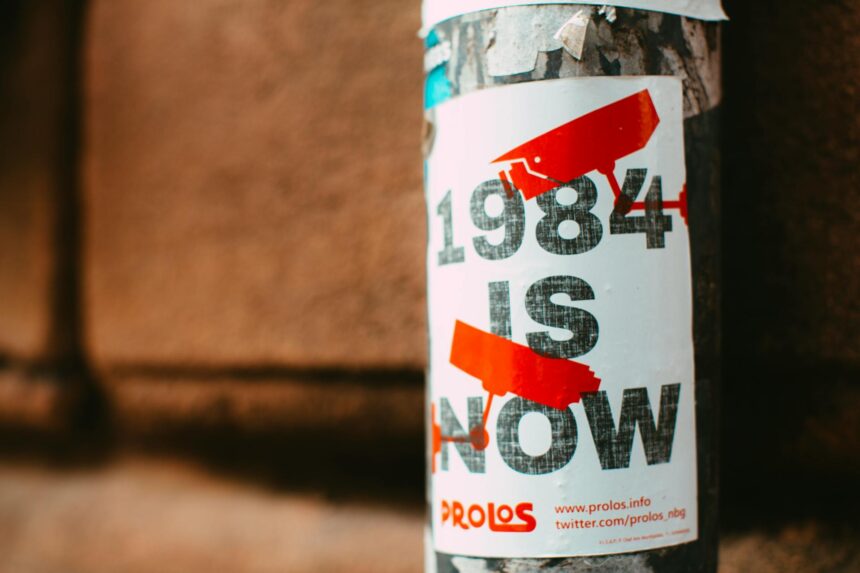
In the grim spring of 1942, with the world tearing itself apart, George Orwell made a chilling observation in his diary. He was reacting to a piece of what he called “stupid” Fascist Italian propaganda which claimed that life in England was so dire the country was on the verge of collapse. The lie was obvious. “If such conditions really existed,” Orwell surmised, “England would stop fighting in a few weeks, and when this fails to happen, the listener is bound to see that he has been deceived.”
But the deception worked, just not in the way one might expect. “In fact, there is no such reaction,” Orwell concluded. “You can go on and on telling lies, and the most palpable lies at that, and even if they are not actually believed, there is no strong revulsion either.”
Eighty years later, Orwell’s ghost haunts the Holy Land. His diagnosis of how societies can drown in self-serving falsehoods is playing out with breathtaking precision in Israel. In the wake of the October 7th attacks and the brutal carnage that followed, a similar dynamic has taken hold. A national myth, forged in the crucible of trauma and amplified by a relentless state apparatus, demands absolute adherence. It is a narrative of pure victimhood, of righteous fury, of a war with no moral complexities. Yet, as a courageous few begin to point out the gaping holes in this official story—the strategic blunders, the ideological follies, the horrifying cost of a secular state’s gambit—they are not met with thoughtful debate, but with a furious, reflexive rejection.
The very dynamic Orwell identified is at work. The official story contains palpable lies and distortions, yet there is no widespread revulsion. Instead, criticism is labeled as treason, and inconvenient facts are dismissed as enemy propaganda. A series of scathing critiques questioning everything from the IDF’s rules of engagement to the morality of placing female soldiers on the front lines are treated not as necessary correctives but as attacks on the national soul. To understand this fierce resistance, one must look beyond simple patriotism and into the dark psychological machinery that locks a society into a state of willful blindness.
The Iron Grip of Blind Belief
When faced with solid proof that a deeply-held belief is wrong, one might expect the believer to reconsider. Yet, particularly amidst the intense unity that characterizes a nation supposedly at war—a unity that often resembles the fervor of a cult—the exact opposite often happens: the belief digs in its heels, becoming even stronger.
This paradox was famously documented in a landmark 1950s study from the University of Minnesota. Researchers Leon Festinger, Henry Riecken, and Stanley Schachter observed a small apocalyptic cult that predicted a world-ending flood on a specific date. When the prophecy inevitably failed, the researchers expected disillusionment. Instead, the group’s leaders announced that the faith of their small flock had been so pure, it had saved the world. The members’ conviction didn’t just survive; it intensified.
This is a textbook case of what Festinger would call cognitive dissonance: the profound mental discomfort we experience when our actions or beliefs clash with new, undeniable evidence. To escape this jarring state, we must either change our belief or reinterpret the conflicting information. For a people bound by the trauma of October 7th, who have invested their entire emotional and social capital in the idea of a just and necessary war, changing the core belief is simply too costly. It would mean admitting that the immense sacrifice has been, in part, for a lie. It would mean facing the ridicule of a hostile world and losing the comfort of a unified community.
It is psychologically “easier” to double down. Strengthening the belief becomes a defense mechanism. The official narrative—that the war is faultless, that the strategies are sound, that the enemy is purely evil while we are purely good—becomes an unshakable dogma, because the alternative is a complete collapse of one’s worldview.
Echo Chambers of the Mind
This initial defense is fortified by two powerful psychological tendencies: belief perseverance and confirmation bias. Belief perseverance is our stubborn inertia, our tendency to cling to what we first believed even after it has been thoroughly discredited. When confronted with evidence of flawed IDF rules of engagement that endanger soldiers, the committed believer does not engage with the substance. They discount the source (“He’s a bitter extremist”), nitpick the evidence (“This is just one isolated incident”), or label it irrelevant (“Wartime requires tough choices”).
This is amplified by confirmation bias, the active hunt for information that supports our existing views. In today’s Israel, it is easy to live in a media ecosystem that exclusively confirms the state narrative. One can scroll for hours through stories of Hamas’s evil and our own heroism, while dismissing any critical analysis as biased or antisemitic. Ambiguous events are instantly interpreted through the lens of the established doctrine, making them seem like further proof of its validity.
Orwell saw this with stunning clarity. “Thus before the war the pinks believed any and every horror story that came out of Germany or China,” he wrote in June 1942. “Now the pinks no longer believe in German or Japanese atrocities and automatically write off all horror stories as ‘propaganda.’ In a little while you will be jeered at if you suggest that the story of Lidice could possibly be true.” The political winds shift, and suddenly, truth becomes a matter of allegiance, not fact.
The Moral and Mental Cost of Delusion
But this is not just a passive, subconscious process. In a society under extreme stress, the refusal to see contradictory evidence becomes an active, willful choice—a moral and intellectual failure.
It is a rejection of mental effort. Grappling with the arguments that modern Zionism has become a “secular betrayal,” or that it follows a Machiavellian logic that sacrifices its own people, requires immense intellectual and emotional labor. It is far easier to retreat into the comforting certainty of shared dogma, to enjoy the effortless omniscience that comes from a pre-packaged worldview. This relieves the individual of the burden of independent thought and first-hand inquiry.
This leads to a refusal to make inferences or recognize context. Evidence is rarely self-explanatory. When the Germans announced they had exterminated the village of Lidice, they provided a list of justifications: the villagers had supported assassins, harbored illegal radios, and held anti-Reich views. A critical mind would infer the monstrous disproportionality of the response. But the propagandized mind, as Orwell noted, loses the ability to assess information within its broader, real-world setting. Similarly, when critics present well-documented evidence that certain policies are failing or are based on a flawed, “feminist folly,” the context is stripped away. The discussion is reframed as an attack on equality or progress, rather than a pragmatic critique of military readiness.
Underlying all of this is a profound hubris. It is the excessive pride that makes it impossible to admit error. For a nation that sees itself as a light unto the nations, the suggestion that its foundational ideology might be flawed, or that its army—the most sacred of all Israeli institutions—is operating under a deluded and dangerous ethos, is an unbearable insult. To concede the point would feel like a personal and national defeat.
At its darkest, this willful blindness bleeds into what can only be described as wickedness: a conscious choice to perpetuate a falsehood for personal or political gain. Leaders may know the evidence is contradictory but choose to mislead the public to maintain power, control, and the veneer of righteousness. For their followers, it can manifest as a choice to uphold a system they suspect is flawed because the benefits of belonging and certainty outweigh their commitment to truth.
A Sacred Cow on the Altar of Truth
This entire framework explains the furious reaction to the evidence presented by critics like Steve Rodan, whose book In Jewish Blood argues that Zionism has historically involved sacrificing the well-being of the Jewish populace for the benefit of elites and foreign powers. For the committed Zionist, this is not a historical argument to be debated; it is blasphemy.
The cognitive dissonance is immediate and overwhelming. The cherished belief in Zionism as a purely benevolent liberation movement clashes violently with evidence of its cynical, realpolitik core. To resolve this, the believer must intensify their faith. They engage in belief perseverance and confirmation bias on a grand scale. They discount the source: “This is anti-Zionist propaganda.” They seek confirmation by focusing only on the moments of national triumph, while dismissing the stories of sacrifice and betrayal as tragic but necessary anomalies. They refuse to engage with the mental effort required to process a complex, multi-volume historical work, preferring the simple, heroic tales of official history.
Orwell’s words from April 1942 echo with haunting relevance: “We are all drowning in filth. When I talk to anyone or read the writings of anyone who has any axe to grind, I feel that intellectual honesty and balanced judgement have simply disappeared from the face of the earth. Everyone’s thought is forensic, everyone is simply putting a ‘case’ with deliberate suppression of his opponent’s point of view.”
This is the state of Israeli discourse today. It is a nation of people putting on a ‘case,’ utterly insensitive to any suffering except their own. The intellectual honesty required to confront the possibility that the nation’s foundational beliefs have led it into a catastrophic dead end has vanished, replaced by the paranoid, self-sealing logic of a cult. “All power,” Orwell lamented, “is in the hands of paranoiacs.”
The tragedy is that the evidence is there, just as the German announcement about Lidice was recorded on gramophone discs for all to hear. The critiques are published. The casualty numbers mount. The strategic goals remain elusive. But the palpable lies continue, and while they may not be fully believed, there is no strong revulsion.
There is only the grim, grinding machinery of a nation doubling down on its delusions, marching deeper into a darkness of its own making, while the ghost of a long-dead English writer whispers, “I told you so.”