



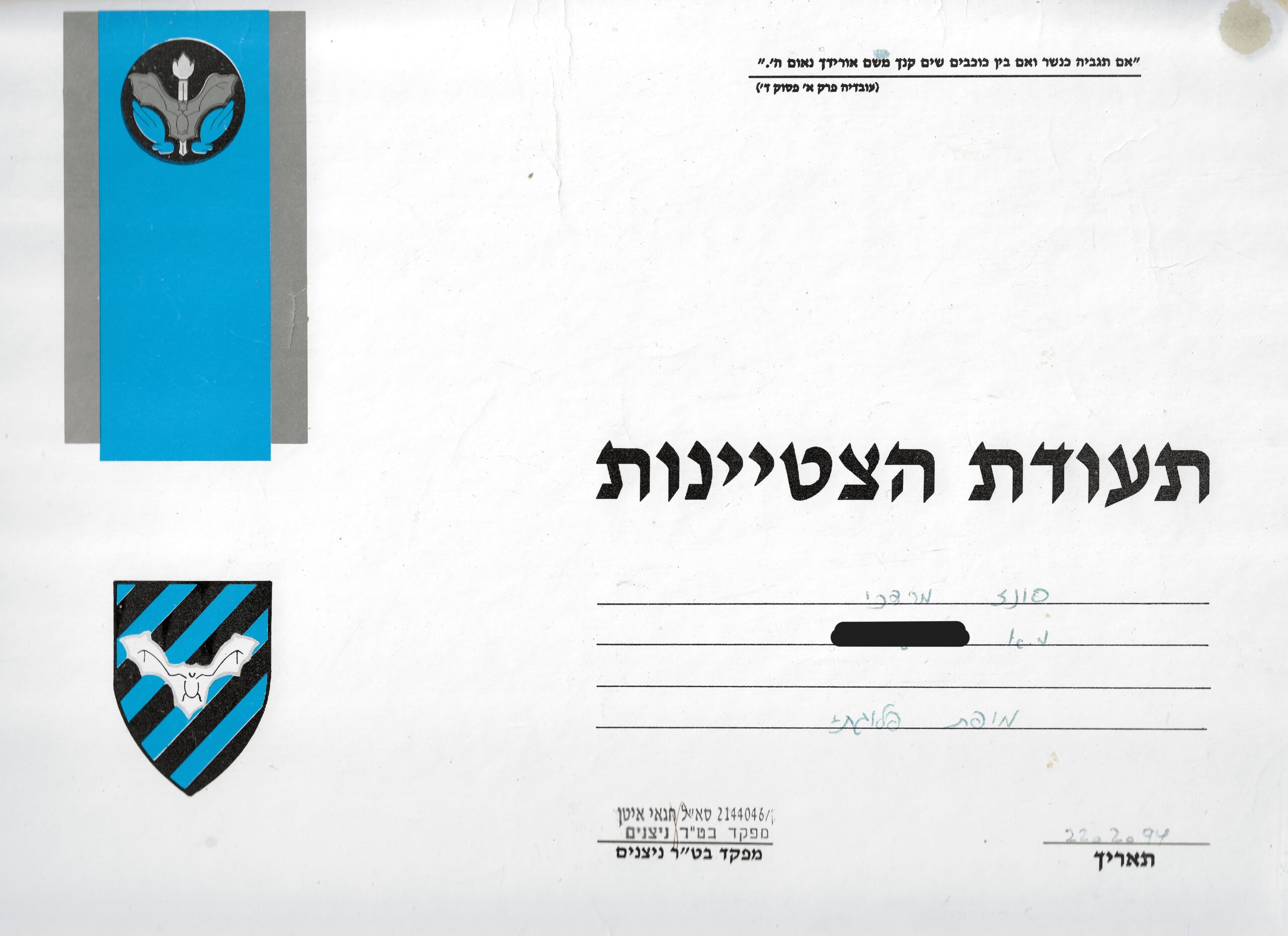
“Mofet Plugati” is an IDF commendation for exemplary service, often awarded in recognition of outstanding performance at the company level. A pluga (company) in the IDF is a unit typically numbering around 100–150 soldiers, depending on the branch and role.
I served in the IDF and received this commendation in 1994. In addition to my army service, both before and after, I spent years studying in Lithuanian and Chassidic yeshivas and kollelim, beginning at age 18. Many people who criticize Haredim for not serving in the army have never been in the army themselves, and many have never spent meaningful time inside a Haredi yeshiva or kollel. I have lived in both worlds.
For most of my life I believed in a simple contract: the State of Israel asks its sons to serve, and in return it does everything in its power to bring them home and to make that service meaningful. I took that contract seriously when I wore the uniform.
Even while I was still serving, and in the years immediately afterward, I saw policies and orders that already troubled me deeply. In reserve duty in the late 1990s, for example, we received clear instructions from our platoon commander: if rocks or cinder blocks were thrown at our bulletproof jeeps, we were not to respond — we were simply to keep driving.
The explanation given was that, because the jeeps were armored, there was no danger to our lives. The operational message was to avoid contact rather than to confront threats. Similar patterns appeared elsewhere: a strong emphasis on restraint, combined with the understandable fear among soldiers that opening fire — even when it might have been justified — could lead to investigation or prosecution.
These were not isolated incidents. They reflected a deeper doctrinal and legal environment that already placed heavy restrictions on soldiers’ ability to respond effectively. That environment did not begin after my service. It was dominant throughout.
Over the years that followed, these problems did not improve in any fundamental way. They continued — and in some respects deepened. The events of October 7 brought many of them into the sharpest possible relief.
I still believe in the idea of meaningful service to the Jewish people. What I cannot accept is sending another generation into a system whose basic approach to soldier safety, operational effectiveness, and priorities has not been fundamentally corrected since the time I myself served.
I did not send my sons into this army. Not because I oppose service in principle. I took my own service seriously, and I was recognized for it. I did not send them because I could not look them in the eye and tell them that the system they would be entering was worthy of the sacrifice it demands.
The problems are visible in the Rules of Engagement that, in practice, often require our soldiers to take on extra risk — to hesitate, to verify, and to expose themselves to lethal fire — even when facing an enemy that operates from within civilian areas and makes no such demands on itself.
When the enemy uses human shields as a deliberate tactic, our soldiers end up paying an additional price in blood to meet standards their enemies openly reject. That asymmetry has become normalized.
It is visible in the decision to place women in close-combat roles for which average physical differences in strength, speed, load-bearing capacity, and injury resilience make them unsuitable.
October 7 made this concrete. The observation unit at Nahal Oz was overrun in the first hours. Sixteen female soldiers were killed and seven were abducted. Placing women in positions that expose them to direct ground combat against determined terrorist forces creates predictable vulnerabilities that no amount of training fully erases.
It is visible in the hollowing out of real combat mass in favor of technology and social priorities that have nothing to do with winning wars. Technology is a tool. It is not a substitute for soldiers who can seize and hold ground.
I would be willing to advise my grandsons to serve only when several fundamental conditions are met.
The Rules of Engagement must be rewritten so that, in active combat zones, the safety of our soldiers and the success of the mission come first — not last. When the enemy operates from within civilian areas and uses human shields as standard procedure, our soldiers should not be required to absorb extra risk in order to meet standards the enemy itself rejects.
The army must return to a doctrine that values real combat mass, offensive spirit, and the ability to actually defeat the enemy, rather than managing conflicts indefinitely with technology and restrictive orders as substitutes.
Women must be removed from close-combat roles in infantry, armor, and special forces. Lethality and unit effectiveness must remain the only standards that matter in those roles.
Beyond fixing the army itself, I believe we also need a broader vision for how the Jewish people maintains both its physical strength and its spiritual core. One idea that deserves serious consideration is the creation of a Torah Education Corps (TEC).
Just as a soldier defends the body of the nation, the TEC would defend its soul. Under such a framework, exemptions from combat service would be granted only to those who enlist in this Corps, operating under a strict “Redistribution of Torah” model:
- The “Ilui” Standard: The top 5% of scholars would retain their exemption as “Spiritual Special Forces,” continuing their advanced studies uninterrupted.
- The Teaching Requirement: It is not enough to sit and learn in isolation. Members of the TEC would spend a significant portion of their service time deployed to community centers, public schools, and peripheral towns — actively teaching Jewish law, history, ethics, and values.
- Justice of Mission: A soldier who knows why he fights is a soldier who wins. The TEC ensures that the nation’s youth — and the broader public — understand the moral and historical foundations of Israel’s right to exist, defend itself, and fulfill its destiny.
We are not asking for another committee or a multi-year plan. We are talking about the next generation. We are the parents. We hold the ultimate leverage: the manpower of the Jewish state.
Fix the Rules. Restore the Ranks. Return the Army to its core purpose — defeating the enemy and protecting the soldier. And build parallel frameworks, like a Torah Education Corps, that strengthen both the sword and the spirit.
When those corrections are made — clearly, seriously, and not through slogans — I will be ready to tell my grandsons that the army is once again worthy of their service.
Until then, I will not.


Bs”d. Dear Mordechai, Shalom Aleichem! Yes, i can understand and do understand, why you could not send your sons. It is a terrible situation! It hurts me to see, how institutions of the state have become disfunctional. Wishing you courage to continue your writing! I am in support of you: you are spot on! Warmest regards, Meir.