



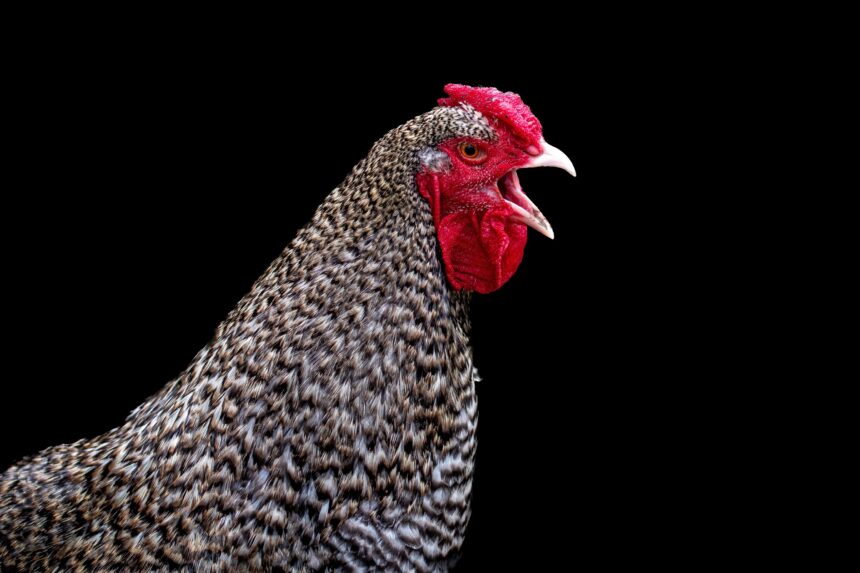
At first glance, the humble chicken seems an unlikely candidate for a philosophical revolution. A creature at the very bottom of the food chain—defenseless, slow, and seemingly destined for extinction in a “red in tooth and claw” world—it nonetheless has persisted in the billions.
This simple observation cuts to the heart of how we understand reality itself: Does the continued existence of such “unfit” animals disprove the foundational secular doctrine of “survival of the fittest”?
The Secular Challenge: Can Blind Nature Explain It All?
When examined through pure logic, two competing worldviews emerge. The mechanistic view, rooted in modern evolutionary biology, claims that the continued existence of prey animals like chickens is simply an “emergent outcome.”
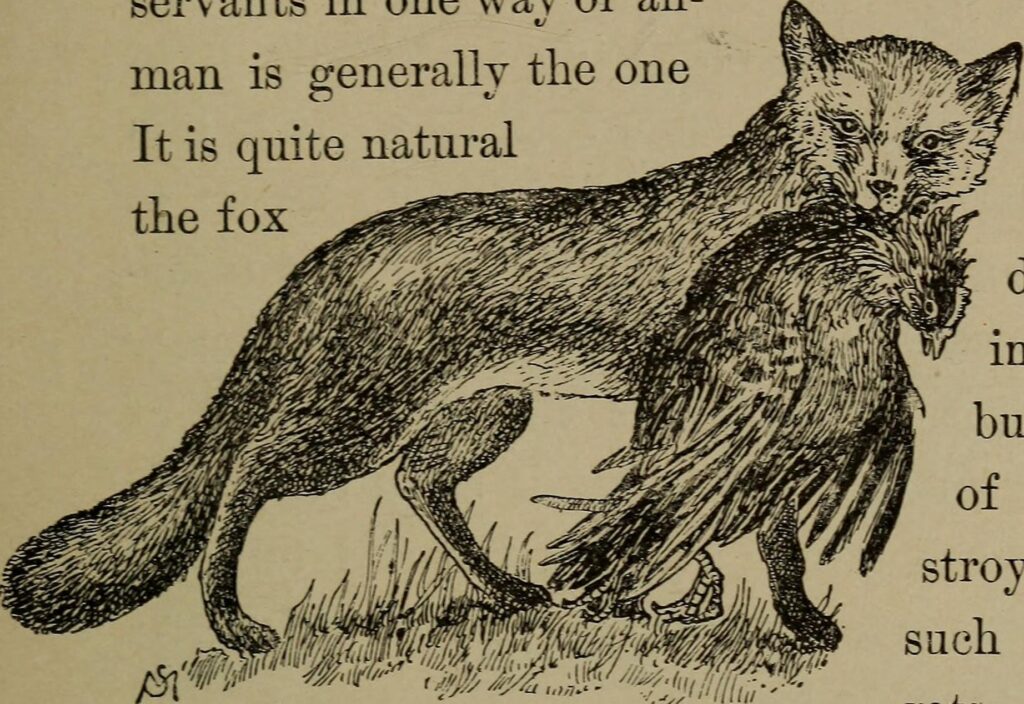
In plain language, this means the survival of these animals supposedly just happens automatically as a side-effect of basic natural processes, without any deeper purpose or guiding force. Scientists use mathematical models known as Lotka–Volterra equations to try to show how populations of predators and prey can rise and fall together in repeating cycles — for example, when there are many prey, predators increase, then the prey decrease because they are being eaten, causing the predators to decrease as well, allowing the prey to recover, and so on.
They also speak of “frequency-dependent arms races,” in which predators gradually become better hunters while prey species become better at escaping or reproducing faster, creating an ongoing back-and-forth adaptation between the two. In this account, the chicken survives because it has found its own small corner in nature, and its high rate of reproduction keeps its numbers steady even though many are eaten.
Where the Mechanistic View Falls Short
Yet when we examine this view more closely, a serious weakness appears. The doctrine of “survival of the fittest” often collapses into a simple tautology: “Who survives? The fit. Who are the fit? Those who survive.”
This circular statement explains nothing new. When the theory tries to account for the stable “balance” we see in nature — the fact that food chains remain steady instead of collapsing into total dominance by predators or complete extinction — it does not actually derive that balance from its most basic idea: that some animals simply survive and reproduce more successfully than others.
Instead, the “balance” is quietly added as an unstated assumption in order to make the model fit what we actually observe in the real world. The theory itself would naturally lead us to expect one side or the other to win out completely, yet the balance is simply smuggled in without ever being explained.
Torah Wisdom Provides the Answer
To resolve this impasse, we turn to the giants of Jewish thought. The Rambam (Maimonides), in Mishneh Torah and The Guide of the Perplexed, introduces the concept of the “Necessary Existent” (Mechuyav ha-Metzi’ut).
He explains that everything in creation is contingent — its existence is not guaranteed and depends on outside causes. For anything at all in the universe to continue existing, there must ultimately be an uncaused Being — a Necessary Existent — who serves as the solid foundation and source of all reality.
Without this uncaused ground of existence, the entire chain of being would have nothing to rest upon and could never persist.
The Kuzari Principle and the Singularity of Jewish History
But we are not left with an abstract First Cause. Rabbi Yehuda Halevi, in The Kuzari, advances the discussion with the Kuzari Principle. Unlike religions founded on private revelations to a single individual, Judaism rests on a public, national revelation at Mount Sinai—witnessed by an entire people and transmitted as living family history. A fabricated national story of this magnitude would have been rejected by later generations.
This same principle illuminates the Jewish historical experience. As recently demonstrated in these pages in How a Singularity in 1948 Ended the Secular Enlightenment and The Singularity of Singularities: From Global Totalism to Hashem Echad, the rebirth of Israel and the miraculous survival of the Jewish people defy every purely secular, mechanistic explanation of history. Like the “protected” chicken, the Jewish people should not, by natural law, have endured the predators of exile—yet we did.
Continuous Creation: The Teaching of the Tanya
The Tanya, in its second section Shaar haYichud v’haEmunah by Rabbi Schneur Zalman of Liadi, supplies the metaphysical mechanics. Creation is not a one-time event in the distant past. Every existent thing is continuously recreated yesh me’ayin (something from nothing) by G-d’s life-giving “speech.”
Were that Divine energy to withdraw for even an instant, the chicken, the predator, and the entire universe would instantly revert to absolute nothingness.
What we call the laws of nature are therefore not independent mechanisms—they are the ongoing expression of G-d’s will.
Hashgacha Pratit and Simple Faith
This brings us to the heart of the matter: hashgacha pratit—personal Divine Providence. The teachings of Rebbe Nachman of Breslov and his foremost disciple Rav Nosson of Breslov insist there are no “blind” mechanistic laws operating on their own. What appears to us as nature is merely a garment for the purposeful, volitional Will of the Creator.
Every movement in the chicken coop and every turn in Jewish history is under direct Divine supervision, orchestrated for ultimate spiritual rectification. Rebbe Nachman calls us to emunah peshutah—simple, pure faith—that sees beyond the limits of intellect.
A Daily Reminder in Our Diet
It is no coincidence that the Torah permits us to eat only certain animals—such as the chicken—that, like the Jewish people themselves, generally cannot survive in the wild without protection. Our very diet becomes a daily reminder of total dependence on the safeguarding hand of the Almighty.
The only logical conclusion that fully accounts for the persistence of the system—without tautology, without smuggling in unexplained “balance,” and without leaving contradictions unresolved—is a volitional Creator who continuously sustains, directs, and infuses purpose into all of creation.
Torah does not merely add mysticism; it demonstrates that anything less than this volitional, personal G-d renders both nature and Jewish history incoherent.
Emunah is not anti-reason—it is what remains when reason has done its utmost and still points beyond itself.