

Korach’s Rebellion and the Metaphysical Rupture
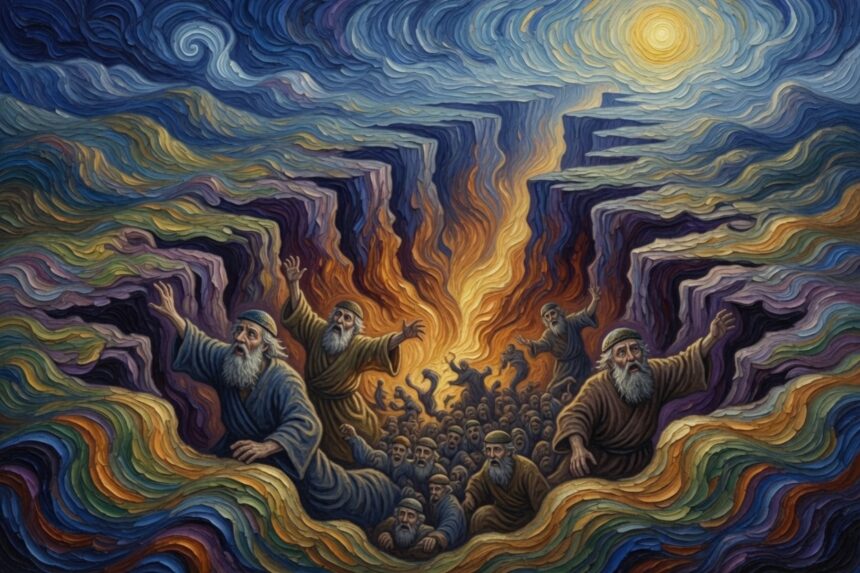
In the opening of Parshas Korach, the Torah states simply: “And Korach took.” The ancient Aramaic translator Targum Onkelos renders this phrase as V’isp’lig Korach, meaning “And Korach split away” or “And Korach divided a faction.” This translation is not merely a stylistic choice. It reveals a deep metaphysical truth: Korach’s sin was not primarily one of physical acquisition or a standard grab for power, but a metaphysical act of rupture. Korach attempted to split, compartmentalize, and ultimately sever two essential spiritual archetypes: the Tzaddik, representing the spiritual guide, and the Lamdan, representing the analytical scholar.
To understand this split, we must look to the teachings of Rebbe Nachman of Breslov and his main disciple, Reb Noson, in Likutey Halakhos. Reb Noson explains that human spiritual life is held together by two inseparable dimensions. The first is Bris Ila’ah, the Higher Covenant, which is the realm of absolute holiness, self-nullification, and direct connection to the Infinite Light. This dimension is embodied by the Tzaddik, the living spiritual master who acts as an ontological bridge between heaven and earth.
The second is Bris Tata’ah, the Lower Covenant, which represents the analytical, boundary-drawing realm of Jewish Law, specifically the rules of what is permitted and forbidden. This is the primary domain of the Lamdan, the analytical scholar.
The Vowels and the Letters: The Breslov Framework
To illustrate how these two forces must interact, Reb Noson uses a beautiful linguistic metaphor. The Tzaddik corresponds to the nekudos, the Hebrew vowel points, while the Lamdan corresponds to the osiyos, the letters themselves. Letters without vowels are static and lifeless, resembling a body without a soul. Conversely, vowels without letters are invisible and have no concrete shape, meaning they cannot express themselves in the physical world.
In the same way, the intellectual rules of the Torah and its vibrant spiritual passion, or kissufin, must remain in an unbreakable, organic unity. If they are severed, the Torah loses its life-giving force and is reduced to sam ha-mavet, a potion of death.
Korach was a highly distinguished scholar and the head of the Sanhedrin, the high court. Looking at his own prestigious family line and remembering that the entire nation stood at Mount Sinai, he declared that because all the congregation are holy and Hashem is among them, there was no reason for Moshe and Aaron to lift themselves above the assembly.
In essence, Korach argued that the Lamdan’s analytical mind was entirely self-sufficient. He believed that because the people had the law, they did not need the unique spiritual mediation of the Tzaddik, embodied by Moshe, to breathe life into those laws. By elevating Da’as, or pure cognitive intellect, above humble submission to the Tzaddik, Korach created the archetype of academic and legalistic self-sufficiency.
This error is not unique to Korach. Reb Noson connects it to the famous Talmudic figure Elisha ben Abuyah, known as Acher, who cut the plantings by separating the structural systems of Jewish thought from their living spiritual roots. In both cases, the analytical intellect, when isolated from the Tzaddik, became cold, sterile, and arrogant.
Cosmic Origins: Static Intellect versus Dynamic Growth
This drive to isolate the abstract intellect from physical, embodied existence is not a modern development. It is a cosmic struggle that dates back to the creation of the world. The Midrash teaches that when the Creator contemplated making human beings, He consulted the ministering angels. Factions of these angels, led by Shamchazai and Azazel, objected fiercely, asking what man is that G-d should remember him.
In the Breslov framework, these angels represent the ultimate sterile, detached Lamdan. They are beings of pure, static intellect and unchanging form who live in a perfect realm free of physical conflict, temptation, and material change. To them, creating a physical human being—who is messy, emotional, and prone to error—seemed like a design flaw. They preferred static, conceptual perfection over the messy, dynamic process of physical spiritual growth.
To show the limitations of this detached intellectualism, G-d brought the animals before the angels. The angels could not identify or name them according to their inner spiritual essences. Yet, Adam immediately saw their core spiritual natures, naming them Shor, Chamor, Sus, and Gamal, and then identified the Creator Himself as Hashem.
Furthermore, when those same protesting angels, such as Uzza and Azazel, were allowed to descend to earth, they immediately fell into the basest physical temptations. Their downfall proved a vital point: pure, theoretical intellect, when isolated from the daily struggles of the human soul, is incredibly fragile and self-destructive. The divine response proved that the purpose of creation is not angelic perfection, but the integration of heaven and earth through a human being who unites body and soul under the guidance of the Tzaddik.
These two approaches reveal two fundamentally opposed cosmic orientations. The split, represented by Korach and the angels, relies on a thinking mode of analytical isolation, separating outer rules and structures from their inner spiritual essence. This orientation thrives in sterile, purely academic, or abstract realms, but its ultimate result is vulnerability to material corruption and a descent into the spiritual abyss.
On the other hand, the integration represented by Adam and Moshe is a dynamic synthesis. It unites the body and the soul through humble submission to the Tzaddik, operating within a dynamic material existence that is transformed into a physical dwelling place for the Divine. This path leads to the elevation of our physical nature and ensures eternal spiritual continuity.
The Theological Split: Visualizing the Wall of Separation
Just as the angels sought to sever the messy, dynamic vessel of human physical life from its intellectual source, early Christianity translated this same metaphysical split into the arena of global theology. This historic transition reveals that the dynamic of the “split away”—the isolation of the body from the animating soul—is not confined to cosmic Midrash. In the theological realm, the division between the mechanical letter of the law and the fluid spirit of salvation replicates the exact division of osiyos and nekudos, establishing a visual and conceptual wall of separation between heaven and earth.
At its core, Christian theology is built on separating the Law, which is the mechanical, legalistic Lamdan component, from righteousness, grace, and salvation, which represent the experiential, spiritual Tzaddik component. This philosophy is physically encoded in its central symbol, the cross. Rather than acting as a living bridge that connects the physical and the spiritual, the horizontal crossbar functions as a dividing wall.
Visually, the vertical section below the crossbar, representing the earth, is much larger than the section above it, emphasizing a vast, unbridgeable chasm between G-d and man. This design reflects the Pauline theology found in the “New Testament,” which claims that Jesus set aside the law with its commands and regulations in his flesh.
By dismissing physical commandments as obsolete, legalistic burdens unable to bring genuine salvation, and by reducing righteousness to an internal state of faith, Christianity codified Korach’s error on a global scale, severing the structural, legal body of the covenant from its living spiritual soul.
The Secular Split: Objectivism and the Analytic-Synthetic Dichotomy
This theological division between the structural law and the saving spirit did not vanish with the secularization of the West; it merely shifted its attire, moving from religious dogma into secular epistemology. When the Enlightenment attempted to build a worldview independent of revelation, it carried the same division of osiyos and nekudos into its theory of knowledge. The separation of the structural letters of logic from the animating vowels of experience reappeared as the absolute divide between the analytic and the synthetic—the ultimate philosophical divorce of mind from reality.
Under this framework, analytic propositions are defined as statements that are logically necessary but empty of factual content about the real world, such as stating that all bachelors are unmarried. Conversely, synthetic propositions are said to describe real-world, empirical experiences but are claimed to lack logical necessity, such as noting that the sky is blue. This framework attempts to divorce logic from actual experience. In this view, logic becomes an arbitrary game of manipulating symbols, acting as a secular Lamdan without a Tzaddik, while the physical facts of reality are rendered fundamentally unknowable or chaotic.
Objectivist epistemology rejects this split, asserting that logic is simply the art of non-contradictory identification based on the Law of Identity, where A = A. Genuine knowledge can only come from applying logic to real, sensory experience.
The Rationalist Fear of Arbitrary Whim
To understand the power of this secular philosophy, we must first recognize the earnest intellectual concern that drives it. Secular rationalists and Objectivists are motivated by a deeply held fear: that admitting any transcendent, supernatural source of reality inevitably invites the chaos of irrational mysticism.
Historically, when human reason was subordinated to arbitrary mystical whim, the result was the suspension of scientific inquiry and the onset of intellectual dark ages. By declaring that existence is a self-sufficient primary, Objectivists are earnestly seeking to protect the absolute reliability of human reason, free will, and the logical consistency of A = A from being rendered arbitrary by what they believed to be a capricious deity.
Yet, in its very effort to rescue the physical world from arbitrary logic, Objectivism succumbs to its own version of Korach’s error. Leonard Peikoff writes:
The fundamental error in all such doctrines is the failure to grasp that existence is a self-sufficient primary. It is not a product of a supernatural dimension, or of anything else. There is nothing antecedent to existence, nothing apart from it – and no alternative to it. Existence exists – and only existence exists. Its existence and its nature are irreducible and unalterable.
By declaring physical existence to be a “self-sufficient primary” with nothing antecedent to it, Objectivism attempts to isolate the material universe from its transcendent source. This is the metaphysical equivalent of Korach’s rebellion. Objectivism treats the lower covenant of nature, identity, and logical consistency—Bris Tata’ah—as an absolute that is independent of any higher reality. In doing so, it attempts to sever the physical letters of creation from the divine vowels that animate them, asserting a cold, intellectual self-sufficiency.
The Torah Synthesis: Logic as a Divine Promise
Torah wisdom provides a profound answer to this philosophical impasse, resolving the Objectivist fear without sacrificing the absolute nature of logic. Rabbi Moshe ben Maimon, the Rambam, introduces the concept of the Necessary Existent, or Mechuyav ha-Metzi’ut, in his Mishneh Torah and The Guide of the Perplexed.
The Rambam explains that everything within the physical universe is contingent, meaning its existence is not guaranteed and depends entirely on outside causes. For anything in the universe to persist, there must ultimately be an uncaused Being—a Necessary Existent—who serves as the solid ground and source of all reality, without whom the entire chain of being would collapse.
This relationship is clarified further by the Tanya, in its second section, Shaar haYichud v’haEmunah, by Rabbi Schneur Zalman of Liadi. The Tanya explains that creation is not a static, one-time event in the distant past. Rather, every physical entity is continuously recreated yesh me’ayin—something from nothing—by the Divine speech.
Far from rendering nature arbitrary or unstable, this continuous divine speech is the very guarantor of its absolute consistency. The laws of nature are therefore not independent, self-sufficient mechanisms, nor are they subject to whimsical change; they are the ongoing, active, and perfectly consistent expression of the Divine will.
In this framework, nature’s consistency is a divine promise. Objectivism’s formula of A = A is correct, but its permanence is actively maintained by continuous creation. The spiritual vowels (nekudos) do not erase the structural letters (osiyos) of logic and nature; they give them life, meaning, and eternal stability.
This metaphysical reality is verified on the stage of human history through the Kuzari Principle of Rabbi Yehuda Halevi. Unlike other belief systems, Judaism rests on a public, national revelation at Mount Sinai, witnessed by an entire people. This public foundation aligns with the singular, miraculous survival of the Jewish nation. The miraculous survival of the Jewish people defy every purely secular, mechanistic explanation of history. Like a defenseless creature surviving in a den of predators, the Jewish people continue to endure because physical laws are not the ultimate, self-sufficient arbiters of reality.
This brings us back to the teachings of Rebbe Nachman and Reb Noson regarding hashgacha pratit, or personal Divine Providence. There are no blind, mechanistic laws operating on their own. What appears to us as independent nature is merely a physical garment for the purposeful, volitional Will of the Creator.
Through emunah peshutah, or simple, pure faith, a person is able to look beyond the limits of cognitive intellect. This faith does not reject logic; rather, it recognizes that logic and physical existence are contingent realities rooted in a higher, divine unity. By binding the intellect to this divine source, the false self-sufficiency of the material world is shattered.
The Downstream Consequence: The Mechanical Model of Medicine
When a philosophy treats physical existence as an isolated, self-sufficient primary, this conceptual split inevitably trickles down into our daily lives and applied sciences. If the letters (osiyos) of physical reality are viewed as entirely independent of their animating spiritual vowels (nekudos), then the human body itself must be treated as a purely mechanical absolute. This cold, sterile view directly spawns the modern clinical model of medicine, where the human being is reduced to a biological machine, entirely devoid of a living, integrated soul.
In his book Confessions of a Medical Heretic, Dr. Robert Mendelsohn argues that the modern Western medical model functions less like objective science and more like a dogmatic religious institution, which he terms the Church of Modern Medicine. In this system, physicians operate as powerful priests, hospitals serve as temples, and standardized protocols and drugs act as rituals and sacraments.
Here, rigid institutional authority and mechanical procedures, representing the cold Lamdan dimension, are elevated far above the living, dynamic vitality of the patient, which is the holistic, Tzaddik dimension of health. The result is a system that treats diseases as isolated mechanical variables while ignoring the organic, integrated reality of the human being.
The Modern Jewish Dilemma: Split Camps
The most painful consequence of this split is how it has affected the Jewish people. When we unconsciously absorb this secular and Christian separation, the Tzaddik and the Lamdan are treated as if they cannot coexist, splitting modern Jewish life into two intellectually weakened camps.
The first camp consists of hyper-rationalists who reduce Torah to cold, academic, and purely legalistic analysis. In this approach, the spiritual, experiential, and metaphysical dimensions of Judaism are ignored or treated as irrelevant. Lacking the living soul of the Tzaddik, this style of study cannot offer a meaningful, transcendent defense of Jewish life, leaving its followers highly vulnerable to secularism and nihilism.
The second camp consists of anti-intellectual pietists who elevate emotional or mystical piety while downplaying or rejecting rigorous logic and structured halakhic analysis. Lacking a coherent intellectual framework, this camp cannot effectively answer tough questions or present the Torah’s truths to a sophisticated, questioning generation.
Both camps accidentally validate the criticisms of our detractors by making it seem as if Jewish law is nothing but cold legalism, and that true spirituality has no relationship to the practical boundaries of Halakha.
The structural parallel across all these domains reveals that Korach’s rebellion was not an isolated historical event, but the emergence of a systemic metaphysical disease. In orthography, when the static letters are separated from the life-giving vowels, the text becomes a lifeless corpse and the Torah is reduced to a potion of death. In the covenant, separating the legal boundaries of the lower covenant from the absolute holiness of the higher covenant results in a sterile legalism that cuts the plantings.
In theology, separating the physical commandments from transcendent grace and salvation turns the crossbar into a dividing wall and declares the Law obsolete. In cognition, separating the analytic propositions of formal logic from the synthetic propositions of empirical experience—or claiming that existence is an independent, self-sufficient primary—divorces the material world from its divine source, reducing logic to an arbitrary game.
In medicine, separating pharmaceutical interventions and standardized protocols from holistic vitality and the body’s natural healing capacity creates a system that treats symptoms as isolated mechanical variables. Finally, in Jewish thought, separating hyper-rationalist textual analysis from emotional pietism and mystical faith leaves both sides mutually exclusive and defenseless against intellectual critics.
The Geopolitical Dimension: The Manpower Crisis and the False Binary
This systemic metaphysical disease—the splitting of the structural body from its animating spiritual soul—has found its most acute, contemporary manifestation on the geopolitical stage of modern Israeli society. In the raging controversy of the Haredi draft debate, we witness the ultimate societal rupture. Just as early theology severed the law from grace, and clinical medicine divorced mechanical protocols from living vitality, the draft crisis pits the physical sword of state defense directly against the spiritual shield of Torah study, presenting a paralyzing, false binary that threatens to tear the nation apart.
To address this crisis honestly, we must first understand the argument of the secular and military establishment, acknowledging the stark, physical reality of the threat. The state of Israel does not exist in an abstract vacuum; it resides in a physical reality where hostile neighbors actively seek its destruction.
Physical land requires physical defense. The manpower shortfall currently facing the Israel Defense Forces is not merely a theoretical talking point or a political maneuver; it is a mathematically real, physical crisis of survival. Standard defense structures require combat mass, physical bodies, and armored brigades to guard the borders. To ignore this physical necessity is to treat the lower covenant of nature and self-defense as non-existent, falling into a sterile, anti-intellectual quietism that abandons the physical vessel (osiyos) altogether.
Yet, successive defense establishments have long used this crisis as a national red herring, drawing attention away from a thirty-year strategic erosion of the physical defense forces. For three decades, successive administrations pursued a “small and smart” military doctrine that deliberately reduced combat mass, shuttered armored brigades, slashed reserves, and subordinated physical ground forces to high-tech systems and economic priorities.
The painful consequences exposed on October 7, 2023, revealed a defense structure hollowed out long before discussions of yeshiva exemptions reached fever pitch. The military manpower shortfall is real, but it is primarily the predictable harvest of these earlier, mechanical choices, not simply the product of young men studying Torah.
By framing this complex strategic crisis as a simple cultural war—pitting the secular draft against yeshiva study—society has fallen victim to Korach’s split. One side insists on drafting Haredim into a secular military structure to satisfy a raw sense of shared physical burden, while the other maintains that Torah study is the ultimate metaphysical shield, rendering the secular military environment incompatible with their spiritual mission.
To heal this societal rupture, it is time for the Haredi community—as an act of historic leadership—to step up and demonstrate how the synthesis of the Tzaddik and the Lamdan operates in the active defense of the nation. It is time to establish a framework that honors both the spiritual special forces and the practical, physical needs of the state, calling the bluff of both extremes.
Reclaiming the Synthesis: The Torah Education Corps
The practical, geopolitical realization of this synthesis is the establishment of an IDF Torah Education Corps (TEC). This structured, state-sanctioned national service track provides a third way. It gives the broader Israeli public a genuine national contribution from yeshiva students, while giving the Haredi world a historic opportunity to actively shape the spiritual character of the country.
Under this model, the ancient Jewish balance of sword and spirit is successfully revived under the conditions of a sovereign Jewish state. The rigorous, structural letters (osiyos) of national defense are reunited with the animating, spiritual vowels (nekudos) of Jewish identity. Just as a soldier defends the physical body of the nation, the Torah Education Corps deploys to defend its soul, showing that the highest spiritual values are organic to the physical survival of the nation.
To preserve the highest levels of advanced Torah scholarship, the program would establish the elite “Ilui” Standard, designated as Israel’s “Spiritual Special Forces.” Comprising roughly the top five percent of advanced scholars, this track represents the pure Bris Ila’ah—the Higher Covenant of absolute holiness, self-nullification, and uninterrupted connection to the Infinite Light.
These elite scholars would be protected to continue uninterrupted study in specialized frameworks, ensuring the intellectual continuity of Torah genius. Rigorous testing and transparent yeshiva recommendations would govern this elite track to prevent abuse, maintaining its status as a sacred, national treasure.
The vast majority of enlistees in the Torah Education Corps would follow a hybrid model of continued intensive Torah study combined with substantial, structured deployment in the field, acting as the living vowels (nekudos) that animate the physical letters (osiyos) of the state. Rather than being placed in combat roles, these participants would deploy as teachers and mentors in public schools, community centers, and development towns across the Israeli periphery.
Their mission would be to teach applied halacha, Jewish history, and ethical foundations, introducing the general public to the beauty of Torah values without coercion. By serving as an active bridge between the Beit Midrash and the secular public square, they translate abstract theology into an active, functional contribution to the state’s resilience.
This model of service is both measurable and accountable, generating tangible public benefits in return for state-recognized exemptions. By integrating Torah students into the national fabric, the Torah Education Corps restores moral legitimacy to the exemption track, offering an honorable path of service that does not ask the Haredi community to abandon its deepest religious commitments.
Through the Torah Education Corps, the physical borders of the nation are defended not by severing the sword from the spirit, but by synthesizing them into an unassailable, unified defense of our eternal heritage.
This is the urgent, practical message of Parshas Korach for our generation.