


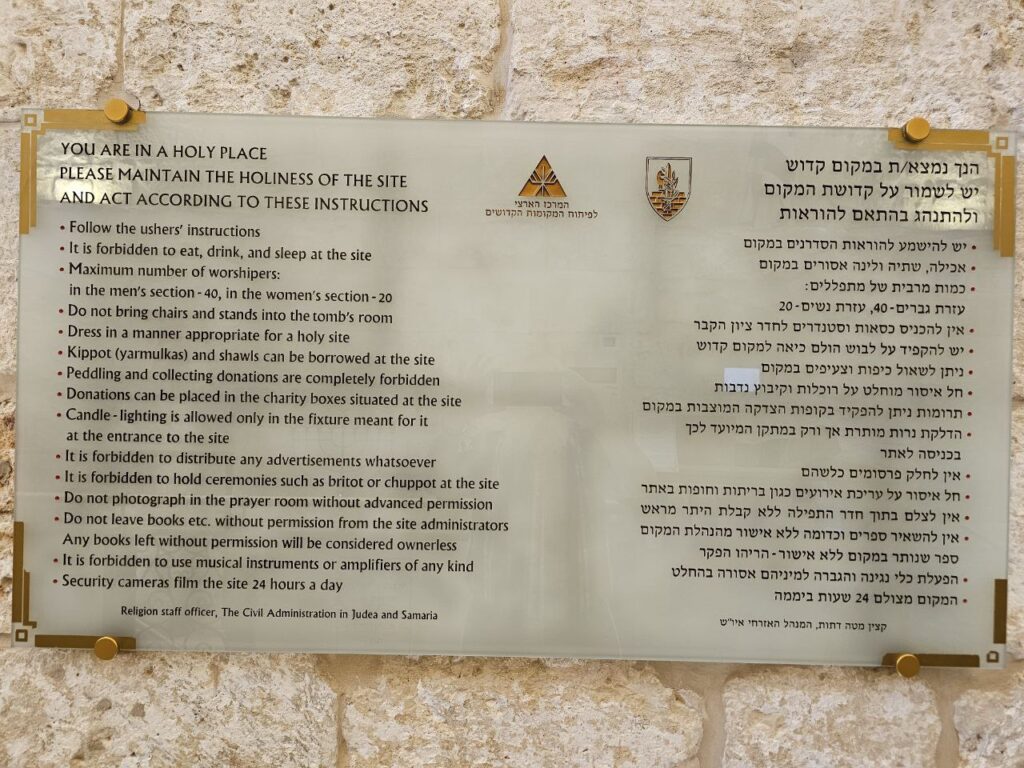
To the uninitiated pilgrim arriving at the Tomb of Samuel the Prophet or ascending the steep slopes of Mount Meron, the signage of the National Center for the Development of Holy Places (“The Holy Sites Authority”) (NCDHP) appears benign, even welcoming. The gold triangle logo suggests stewardship; the turnstiles and security cameras suggest safety.
Yet, an operational analysis of this entity reveals a reality that is far more unsettling than mere administrative overreach. While the NCDHP is not a smoking-room conspiracy, the truth of its function is arguably more dangerous to the principles of Jewish continuity.
It is a state-sponsored patronage machine operating under the guise of religious stewardship. It utilizes the banality of bureaucracy not just to manage these sites, but to establish “controlled environments”—sanitized zones where the indigenous Jewish character of the land is slowly eroded in favor of a sterile, globalist status quo.
The Domestic “Cut-Out”
To understand how the Israeli government manages its most sacred real estate, one must look not to the annals of Rabbinic law, but to the operational playbooks of intelligence agencies as described by former CIA officer and whistleblower John Stockwell.
In his seminal work, In Search of Enemies, Stockwell detailed how the CIA utilized “cut-outs”—nominally independent contractors and air transport companies—to wage war in Angola while allowing the State Department to stand at the podium and truthfully deny official military involvement.
The NCDHP functions as the domestic equivalent of a Stockwellian “cut-out.” By registering as a government association rather than a direct ministry department, it occupies a legal grey zone that provides the State of Israel with the ultimate political asset: plausible denial.
When restrictions are placed on Jewish worship at the Tomb of David, or when the raw, spiritual freedom of Kever Shmuel is hemmed in by perimeter fencing and “temporal containment” (strictly enforced visiting hours), the Prime Minister’s office need not take responsibility for stifling religious freedom. They can simply point to the “independent” managers at the NCDHP who are merely enforcing “OpSec” and “structural maintenance,” even as they face allegations of gross negligence.
Bureaucracy as a Weapon System
Critics often search for a “smoking gun”—a memo from the NCDHP directorate outlining a plot to suppress Haredi worship. But as intelligence analysts know, explicit orders are rarely written because they are unnecessary. The objective is embedded in the mechanism itself.
The NCDHP does not employ security guards; it employs Operational Security. Their mandate is not to maximize spiritual connection, but to minimize “friction”—the Civil Administration’s code word for Jewish assertiveness.
Consequently, the administrative procedures act as a covert weapon. The installation of surveillance cameras, the rigid demarcation of space, and the enforcement of sterile order are not merely logistical choices; they are a campaign of behavioral modification. A “Holy Place” is defined by the living, transcendent clamor for the Divine. A “Controlled Environment,” conversely, is defined by liability insurance, crowd throughput metrics, and silence.
By prioritizing the latter, the NCDHP effectively acts as a counter-intelligence force against piety, ensuring that the “bureaucrat’s desire to control” always triumphs over the “worshipper’s desire to transcend.”
Convergence: Pre-Certifying for Globalist Handover
The ultimate danger of this bureaucratic “grey zone” is geopolitical. The NCDHP is effectively “pre-certifying” Israel’s holy sites for internationalization.
While NCDHP officials may not consciously desire to hand the keys of Mount Zion to the Vatican or the UN, their operational metrics create a convergence of interests. A site that has been sanitized, fenced, monitored, and regulated by a quasi-governmental agency is infinite times easier to internationalize than a site that is wild with indigenous worship.
By adopting the lingua franca of international heritage bodies—universal access, neutrality, and strict liability management—the NCDHP is stripping the sites of their specific Jewish fervor. They are creating the physical and legal infrastructure of an international zone. It is a surrender of territory by increments, measured not in meters of land given away, but in the gradual alignment of local management protocols with globalist “neutral administrator” standards.
The Patronage Paradox
The tragedy of this arrangement is that it is sustained by the very community it disenfranchises. Through the skillful distribution of jobs and contracts—often without the transparency of public tenders—the NCDHP has entrenched itself within the religious political establishment.
It functions as a classic patronage machine, buying the silence of Haredi political leaders with the currency of employment and budget allocations for physical renovations. Religious parties fight to control the NCDHP for its financial benefits, seemingly unaware that the machinery they are funding is designed to undermine their ideological goals. They accept the “gold plating”—the marble floors and air-conditioned halls—without realizing that this financial dependence is exactly what prevents them from challenging the operational doctrine of the site.
A Call to Civic Action
The trend is deeply entrenched, but it is not irreversible. Concerned citizens must move beyond conspiracy theories and engage in targeted civic action to dismantle the mechanism of plausible denial. The strategy must be sequential:
Target the Revenue Stream (Follow the Money): This is the prerequisite for all other actions. Use the Freedom of Information Law to demand the NCDHP publish their tender exemptions and contractor lists. The patronage network is the glue holding this system together; exposing the financial flow breaks the alliance between the religious parties and the bureaucratic state.
Demand Direct Accountability: Once the financial cover is blown, lobby Knesset members to strip the NCDHP of its “Association” status. Fold its responsibilities directly into the relevant ministries. If the government wants to restrict prayer, let a Minister sign the order and face the electorate, rather than hiding behind an unelected CEO.
Occupying the Space: The NCDHP relies on passive compliance. Peaceful, persistent civil disobedience regarding arbitrary “visiting hours” or restrictions on prayer can overwhelm the surveillance state. If the “management” cannot manage, the facade of control crumbles.
Shift the Narrative: Reject the language of “safety” when it is used as a weapon against sovereignty. Demand that “development” be defined not by how many surveillance cameras are installed, but by how freely a Jew can pray in the land of his ancestors.