


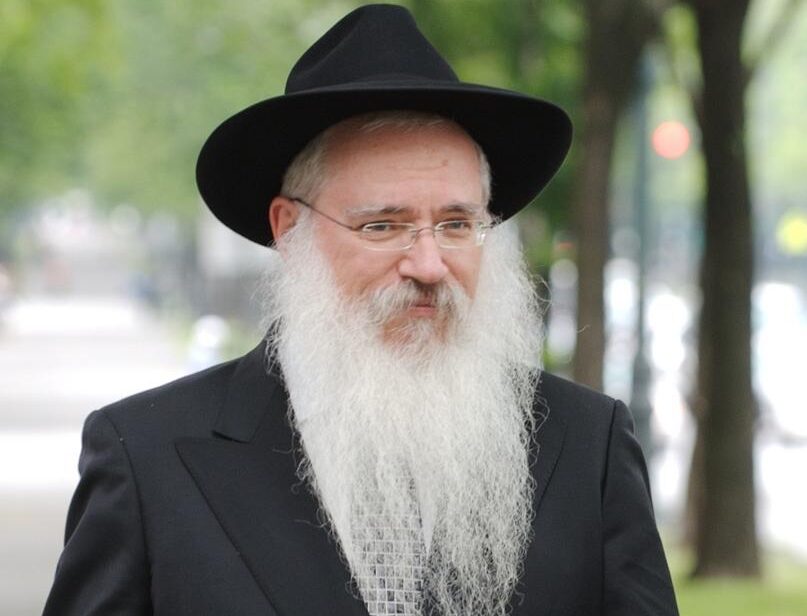
In the passionate, often contentious world of contemporary Jewish thought, few figures spark as much debate as Rabbi Manis Friedman. A charismatic Chabad-Lubavitch rabbi, author, and YouTube sensation with millions of views, Friedman has built a reputation for distilling profound Chassidic insights into accessible, motivational, and inspirational teachings.
But one of his core teachings has unleashed a theological tempest: the simple, staggering idea that “G-d needs you.”
For his critics, this is pure heresy, a dangerous diminution of the all-powerful, perfect Creator. For his followers, it is a revolutionary call to purpose, a confirmation that human lives have cosmic significance.
This clash of ideas is not confined to ivory tower seminaries; it is a digital wildfire. YouTube channels have become battlegrounds, with videos dissecting Friedman’s words racking up thousands of views, turning ancient debates into modern-day clickbait.
But is Friedman’s message a radical break from tradition? Or is he merely rehabilitating a profound and ancient Jewish concept, one deeply embedded in traditional sources?
The answer reveals that Friedman, far from being a heretic, stands on the shoulders of giants, reminding a new generation that our service fulfills a “need on high” (tzorech gavoha) without ever diminishing G-d’s infinite perfection.
The Spark: What Does It Mean for Perfection to “Need”?
At the heart of the firestorm is Friedman’s vision of a reciprocal divine-human relationship. He does not preach a self-help gospel; he preaches a divine mandate. “G-d needs you,” he insists, “and therefore you have got to do your job.”
He is quick to clarify this is not a need born of lack. G-d, being perfect, does not require anything to complete Himself. Instead, Friedman, drawing on Chabad philosophy, uses the analogy of a marriage. Spouses do not “need” each other for survival, but they need each other to express and experience a complete love. Perhaps similarly, the Creator “needs” us not for His own gain, but to manifest His will and goodness in the world He created. It is a need born of relationship, not deficiency.
“Needing nothing means G-d doesn’t get anything from us—He doesn’t get older or stronger,” Friedman argues in one heated exchange. “But needing no one? That’s not perfection; that’s isolation.” This message, that we are not just servants of a distant king but partners with the Divine, is a powerful antidote to modern alienation.
Yet, this language has drawn fierce opposition. Rabbis and online critics accuse him of anthropomorphism, of shrinking G-d to human dimensions. They point to sources like the Book of Job’s assertion: “If you are righteous, what do you give Him?” Their argument is simple: G-d is utterly transcendent, unaffected by human affairs.
Echoes of the Ancients: The Deep Roots of a “Divine Need”
What Friedman’s critics often miss is that his “heresy” is woven into the very fabric of Jewish thought. The concept of tzorech gavoha—a “need on high”—has echoed through the ages, suggesting that our actions have a real, tangible effect on the divine realms.
It begins in the Torah itself. When Hashem says He brought the Israelites out of Egypt “so that I might dwell among them,” the implication is clear: the entire Exodus was orchestrated to fulfill a divine desire for presence in our world. The great medieval commentators Nachmanides (Ramban) and Rabbeinu Bahya revealed the “great secret” that our service, especially the sacrifices, was not for our benefit alone, but to “fulfill a need Above.”
Later Kabbalists continued this idea. Rabbi Meir Ibn Gabbai (Avodat haKodesh) resolved the apparent contradiction—how can perfection “need” anything?—by distinguishing between G-d’s infinite, unknowable essence (En Sof), which is beyond all need, and His manifest emanations (sefirot), which are sustained and unified by our good deeds. Our mitzvot, in this view, are the spiritual fuel that keeps the divine energy flowing into the world.
This idea became a cornerstone of Chassidism, Friedman’s own intellectual home. The foundational text of Chabad, the Tanya, explicitly states that the entire purpose of creation was to make “a home for G-d in the lower realms.” This is not a flaw in G-d, but the ultimate expression of His desire to connect with His creation. Friedman’s teaching is a direct continuation of this lineage. He is not inventing a new doctrine; he is translating a timeless Torah truth into language that speaks to the 21st-century soul.
A Timely Lens: Spiritual Warfare in an Unruly World
Having established these deep traditional roots, we can see how this ancient concept takes on a new urgency in our turbulent times. In the shadow of Israel’s wars and global unrest, Jewish thinkers are framing this divine “need” through a powerful modern lens: spiritual asymmetric warfare.
As recently noted, modern conflict has evolved into “unrestricted warfare”—a strategy that blurs lines and uses every available tool to overwhelm an adversary. Chassidic thought teaches that such physical shifts always mirror a spiritual imperative. If the world has embraced “all-domain” conflict, then our spiritual arsenal must expand to meet it with unrestricted prayer.
This framework perfectly aligns with the tzorech gavoha. Our prayers and good deeds become the ultimate asymmetric response. They allow finite humans to partner with the Infinite, not to fill a divine void, but to reveal G-d’s hidden presence in a fractured world.
In wartime, this partnership becomes a lifeline. As Friedman has stressed since the Simchat Torah attacks, G-d “misses” our service during turmoil, not from weakness, but as a call to draw down divine protection and unity.
This transforms our role from passive observers to active spiritual combatants. Our service is not just a personal obligation; it is our asymmetric edge, our force multiplier, turning finite efforts into infinite impact.
From Traditional Roots to Modern Resilience
Ultimately, the debate over Rabbi Friedman’s words is less about theory and more about application. His detractors cling to philosophical literalism, but in doing so, they miss the life-force and truth of a living Torah given by a living G-d. By first understanding the deep, existential roots of a “divine need,” we can appreciate its profound relevance today.
Rabbi Manis Friedman’s genius lies in his ability to make this misunderstood idea accessible. He challenges spiritual complacency and invites us into a deeper partnership with the Divine.
In an era of profound search for meaning, his message is not just inspiring; it is essential. It tells every individual that their actions matter, that they are not a cosmic accident but an indispensable part of the Creator’s story—a story in which G-d needs us to be the hands through which He reveals His light.
As one viewer commented, summing up the power of this perspective: “In all my years… I never felt I could connect with G-d… until Rabbi Friedman.”

Spot on! Thank you, Mordechai Sones, for writing these illuminating essays.