

The claim that there exists a Judaism independent of rabbinic tradition is not merely historically inaccurate; it severs Judaism from its most profound message: that the Creator intended human beings to be active partners in the ongoing work of Creation.
This partnership is realized precisely through the chain of transmission and participation that begins with Moshe Rabbenu and continues through the sages of every generation.
There is no authentic Judaism besides Rabbinic Judaism. To understand why, we must trace the thread back to its source.
The Eternal Mandate at Sinai
At the very moment of the greatest revelation in human history—the giving of the Torah at Mount Sinai—G-d spoke directly to Moshe with words that established not only the Written Torah but the permanent authority of its primary transmitter:
“And the L-rd said to Moses, ‘Behold, I will come to you in a thick cloud, so that the people may hear when I speak with you and may also believe in you forever’” (Exodus 19:9)
This divine declaration is revolutionary. G-d did not say merely that the people would believe in the Torah or in the commandments. He declared that they would believe in Moshe—in the man, the teacher, the leader—forever. This establishes the principle of mesorah, the unbroken chain of transmission and authority. The belief in the messenger is as eternal and authoritative as the message itself.
This verse underpins the entire structure of Rabbinic Judaism. The Living Mesorah, the explanations, the applications, the debates, and the decisions of the sages are not later additions but the living unfolding of what was entrusted to Moshe. Without this, the Torah would remain a static text, unable to guide a living people through changing circumstances. The rabbinic tradition is the mechanism by which the Jewish people fulfill their role as partners with the Creator—elucidating, applying, and actualizing the divine will in each generation so that Creation itself can be brought to completion.
As the verse in Deuteronomy declares,
“So keep and do them, for that will be your wisdom and your understanding in the sight of the peoples, who, when they hear all these statutes, will say, ‘Surely this great nation is a wise and understanding people’” (Deuteronomy 4:6)
The Lubavitcher Rebbe often emphasized this same principle when he taught that the rabbis are the kings—“Man Malki? Rabanan”—because through their authority in matters such as kiddush haChodesh they determine halakhic reality itself, and because they bear the responsibility to issue clear, public Torah rulings on the most urgent questions of life and national survival.
Even the Jewish people at Sinai, who accepted the Written Torah willingly, required divine coercion to accept the Living Mesorah—the rabbinic revalation and transmission of the divine will. As the Sages teach, G-d lifted Mount Sinai over the heads of the Israelites like a barrel and declared that if they did not accept the Torah in its fullness, they would be buried beneath it. If the Jews themselves needed such persuasion to embrace the complete mesorah, how much more challenging is the hurdle for the nations of the world in recognizing that mankind’s way to the Creator runs through the rabbis and their authoritative tradition.
Rebellion against rabbinic authority is as ancient as it is perennial. In the Wilderness of Sinai, Korach and his followers rose up against Moshe and Aharon, declaring,
“You assume too much; for the whole of the congregation are all of them holy, and the L-rd is among them” (Numbers 16:3)
G-d’s miraculous punishment demonstrated His unequivocal endorsement of Mosaic, and by extension rabbinic, authority. This same spirit of rebellion against the sanctity of rabbinic tradition and the Living Mesorah continues to manifest in every generation among those who seek a Judaism without rabbis.
Remarkably, even the path for righteous Gentiles—the Seven Noahide Commandments—requires clearing this same hurdle. These universal moral laws, whose detailed understanding is found in the Talmud and later rabbinic teachings and nowhere else, cannot be properly observed without accepting the authority of the rabbis as the elucidators of G-d’s will for all humanity.
The Men of the Great Assembly: The First Rabbis
The bridge between the era of prophecy and the era of the sages is the Anshei Knesset HaGedolah, the Men of the Great Assembly. According to tradition, the chain of transmission runs from Moshe to Yehoshua, to the Elders, to the Prophets, and to the Men of the Great Assembly.
Who were these men? They were a body of approximately 120 leading sages, scribes, and prophets who guided the Jewish people in the early Second Temple period. Among their members were the last of the prophets—Haggai, Zechariah, and Malachi—as well as Ezra the Scribe, Nehemiah, Mordechai, and Zerubbabel.
These are not anonymous figures. They are the very same individuals after whom multiple books of the Tanach are named: the Book of Ezra, the Book of Nehemiah, and the books of the last three prophets. The Men of the Great Assembly played a decisive role in shaping what we call the Hebrew Bible. They fixed the canon of the Tanach, determining which books would be included for all time. They grouped the Twelve Minor Prophets into a single book, accepted the books of Ezekiel, Daniel, and Esther, and established the tripartite division of Torah, Nevi’im, and Ketuvim.
Beyond canonization, they transformed Jewish practice in ways that remain foundational: they formulated and instituted the core of Jewish prayer, including the Amidah, the blessings recited before and after meals, Kiddush, and Havdalah; they established the four mitzvot of Purim; and they laid the groundwork for much of the liturgical and ritual framework that defines Jewish life to this day. The Men of the Great Assembly were the first rabbis in the full sense—sages who received the mesorah from the prophets and passed it forward to the Tannaim. The biblical period, in its closing chapters, was already rabbinic in its leadership and in its creative work of preserving and shaping the tradition.
Practices That Reveal the Rabbinic Foundation

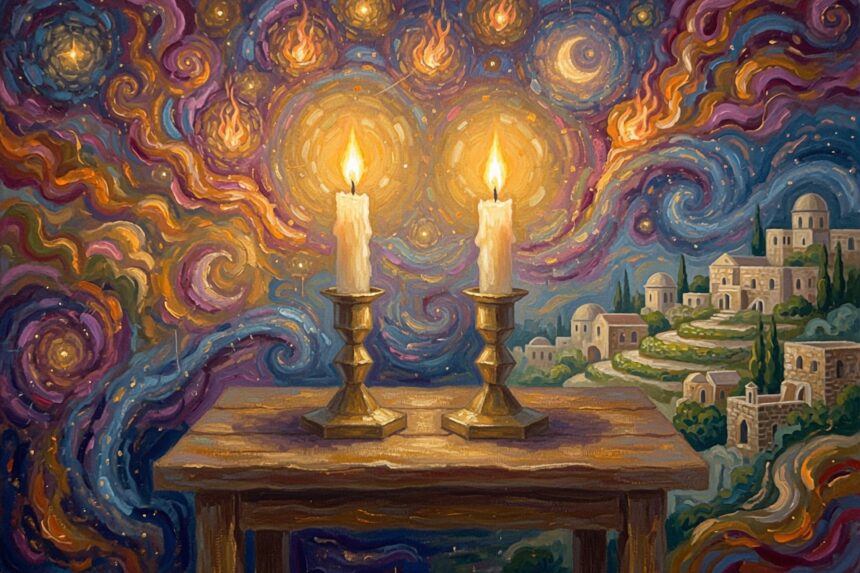
One of the most telling ironies is that many who promote the myth of a non-rabbinic or biblical-only Judaism continue to observe practices whose origins or detailed laws are explicitly rabbinic. Hanukkah—the entire festival, the kindling of lights with its specific halakhic debates, the recitation of Hallel and Al HaNisim—is a rabbinic institution with no mention in the Tanach. Purim observances, while rooted in the Book of Esther, were enacted and detailed by the Men of the Great Assembly and subsequent sages. Shabbat candle lighting is a positive rabbinic ordinance for the sake of shalom bayit. The structure and much of the wording of daily prayer, the Amidah, and large portions of the Siddur were standardized by the Men of the Great Assembly.
Even groups that formally reject the Living Mesorah have developed their own interpretive traditions and do not live in a vacuum of pure Written Torah literalism. These practices are not additions that burden the Torah; they are the very means by which the Torah lives and breathes. They embody the partnership between the Creator and humanity: the sages, through rigorous study and debate, discern how the eternal principles apply in new situations, thereby completing and perfecting the world.
The Modern Inversion of the Title
Yet precisely because the true rabbinic role carries such majestic authority—the power to determine halakhic reality, to protect life through clear psak, and to serve as partners with the Creator—we must confront a painful inversion that has taken hold in our time. One significant mechanism of this dilution is the modern state-sponsored Chief Rabbinate. This structure, imposed by empires and colonial administrations for administrative convenience rather than emerging from the authentic chain of the mesorah, places rabbis in the position of serving two masters. As state officials, they face inherent pressures to align rulings with government policy rather than uncompromised Torah, even on matters of pikuach nefesh and the integrity of Eretz Yisrael.
The result is a class of title-holders whose authority derives more from political appointment than from the living tradition of Moshe Rabbenu and the Men of the Great Assembly. In an era when many who bear the name “rabbi” prioritize institutional self-preservation or external loyalties over fearless service to G-d and the people, we are reminded of the ancient warnings about those who study Torah yet lack yirat shamayim and turn the Mesorah into a tool for self-benefit.
The Lubavitcher Rebbe demanded that rabbis act as true kings—issuing clear, public Torah rulings on the most urgent questions of life and national survival rather than remaining silent or hedging under external pressure. He called upon rabbis to resolve and proclaim that it is forbidden to surrender even a tiny portion of Eretz Yisrael because it endangers Jewish lives, citing the Shulchan Aruch that one must take up arms even on Shabbat to defend a border town when pikuach nefesh is at stake. He insisted that such rulings be publicized strongly and everywhere so that all Jews would know the clear position of Torah.
When the title “rabbi” is attached to those who cannot or will not fulfill this role because of structural conflicts or lack of yirat shamayim, the title itself becomes a source of confusion rather than clarity. The modern state-sponsored model makes genuine independence structurally difficult, turning what should be fearless guardians of the mesorah into functionaries accountable to powers other than the living chain from Sinai.
Restoring the Living Chain
We return to where we began: at Sinai, where G-d declared that the people would believe in Moshe forever. That “forever” is the rabbinic tradition—the living mesorah carried forward by the Men of the Great Assembly, the Tannaim, the Amoraim, the Rishonim, the Acharonim, and the true talmidei chachamim of every generation who fear G-d above all else.
Rabbinic Judaism is not a later layer added onto some pristine biblical core. It is the Judaism that emerged from Sinai, preserved the Tanach, formulated the prayers, and enabled the Jewish people to remain a covenantal partner with the Creator through exile, dispersion, and return. The message that humans are meant to be active partners in Creation is embedded in the very structure of a Torah that requires elucidation, application, and human responsibility.
To claim there is a Judaism besides or against Rabbinic Judaism is to reject the explicit divine guarantee at Sinai, to dismiss the Men of the Great Assembly who sealed our Scriptures and our prayers, and to abandon the partnership model that has sustained Jewish life for millennia.
The path forward is not to diminish the title “rabbi” but to restore its meaning: to demand of those who bear it genuine breadth of Torah knowledge, fidelity to the full mesorah, and the humility to recognize the limits of their expertise—especially when venturing beyond halakhah into the complexities of the world. It is to encourage every Jew to deepen their own connection to the chain: to study Chumash and Tanach with commentaries, to engage with the Talmud and its transmitters, and to appreciate that the rabbis are not obstacles between us and G-d but the very instruments through which the divine will continues to be revealed and enacted.
There is no Judaism besides Rabbinic Judaism—because Rabbinic Judaism is Judaism, the Judaism of Moshe Rabbenu, of the Men of the Great Assembly, and of every generation that has kept the flame alive. Anything less is a severed branch, cut off from the living tree of Torah.
May we merit to strengthen that tree, to honor its true guardians, and to fulfill our role as partners in Creation.