



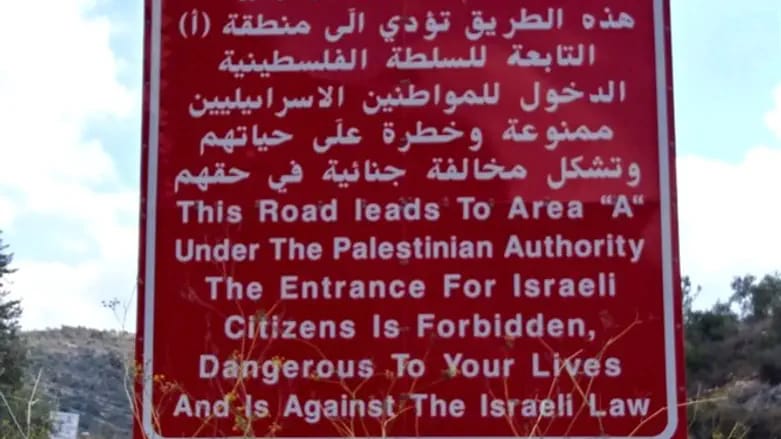
A large red sign stands at the entrance to roads leading into Areas A and B in Judea and Samaria. In clear Arabic, English, and Hebrew they warn Israeli citizens that entry is forbidden, dangerous to life, and against the law.
The State of Israel posts these signs, directing its own Jewish citizens to stay away from parts of the land under its claimed sovereignty. No other country in the world erects such explicit barriers against its own Jews while still insisting on the authority to govern them.
This image captures something essential about the current relationship between the state and the Jewish communities of Judea and Samaria. The same governing apparatus that posts these warnings also removed a veteran security coordinator from Yitzhar on the grounds of “exceeding authority.” It has ordered the dismantling of roadblocks and positions at known points of danger. And it has allowed — and at times amplified — the claim that the residents of these communities constitute a burden on the security forces rather than a strategic asset providing presence, observation, and rapid response deep in contested territory.
Yitzhar’s residents did not remain silent. They organized. They drafted a clear proposal refusing to accept the dismissal, declared that their coordinator continues to hold the role, and established that all future contact with security bodies must pass through him. A petition circulated and gathered signatures. Protests were held outside brigade headquarters. In a short time they demonstrated real coordination and communal will. That energy and unity are real. They reflect people who care deeply about the safety of their families and who are prepared to act together when they feel threatened.
Yet the form this action took remains an appeal to the very system that created the problem. It is a sophisticated and collective request for the authorities to reverse their own decision. It assumes that the proper channel for restoring security is still through the same command structure that removed the coordinator in the first place. Even when framed in strong language, the underlying posture is one of petitioning power rather than questioning whether that power retains the right to make such decisions unilaterally.
This pattern is not limited to one brigade commander’s order. It appears in the removal of physical protections at vulnerable points, in the official and media framing that casts Jewish communities in Judea and Samaria as liabilities, and in the very signs that instruct Jews where they may and may not go in their own land. Each of these actions sends the same message: the state retains the authority to define the terms of Jewish security and presence, and communities are expected to operate within those terms.
The deeper issue is one of consent. A system that repeatedly demonstrates it is willing to endanger Jewish lives in pursuit of other priorities does not lose that willingness simply because communities organize better petitions or more visible protests. Continued participation in the normal rituals of appealing to that system — whether through formal channels or through organized civic pressure — functions as ongoing consent to its authority. It keeps the arrangement intact even while protesting its latest symptoms.
The alternative is not chaos or isolation. It is the deliberate, organized withdrawal of the legitimacy that keeps the current structure in place. This begins with political steps that treat the ballot itself as the mechanism through which consent is granted. Coordinated, public campaigns of non-voting in Judea and Samaria would send a clearer signal than any petition: we no longer accept that the institutions currently making decisions about our security have the moral or practical right to do so without our ongoing agreement. Such campaigns can be paired with the development of parallel community structures for internal decision-making and representation that no longer route every major question upward to a system that has shown itself unreliable.
These steps are difficult. They require communities to accept short-term uncertainty in exchange for long-term clarity about where responsibility actually lies. They also require the recognition that the organizational capacity already demonstrated in recent weeks — the ability to draft proposals, gather signatures, and act together — is precisely the capacity needed to sustain a different posture. That energy does not need to be spent asking the system to correct itself. It can be redirected toward building the political and communal frameworks that no longer depend on that system’s goodwill.
The red signs on the roads will not disappear because better arguments are made to the people who ordered them posted. They will remain standing as long as the communities affected continue to grant the authority that posts them the legitimacy to do so.
The choice before the residents of Yitzhar and similar communities is not between protest and passivity. It is between continuing to negotiate the terms of their vulnerability and beginning the harder work of withdrawing the consent that makes that vulnerability possible.
Yitzhar’s residents live under conditions most Israelis never face. Their frustration is legitimate. Their desire to protect their families is not in question.
The critique offered here is not aimed at their love for their land and homes or their willingness to stand up for them. It is directed at the persistent assumption that the solution lies in becoming more effective lobbyists within a framework that has already shown, through repeated actions, where its priorities lie.
Until that framework itself is confronted — and not merely its latest decision — the red signs will stay in place, and the next dismissal or removal of protection will remain only a matter of time.
The shift in power and responsibility discussed here is not achieved by perfecting the art of appealing to power.
It begins when communities stop assuming that power retains the right to define the terms under which they live and die.