

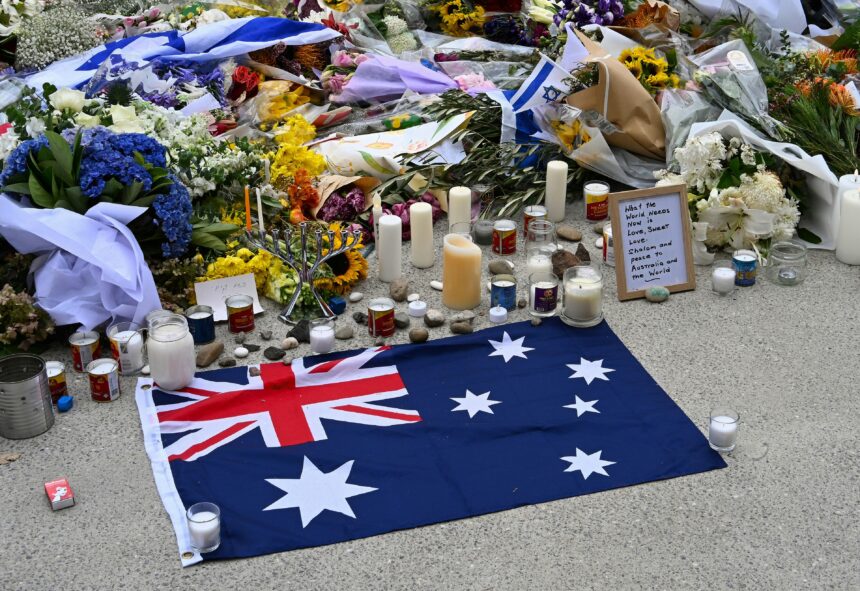
Four months after a father and son attacked a Hanukkah gathering at Bondi Beach, the official story has hardened into something far more contained than the early speculation suggested.
The perpetrators, Sajid Akram and his son Naveed, acted on their own. Australian authorities found no operational ties to any foreign government, no broader terrorist cell, and no evidence of direction from abroad. The attack was classified as ISIS-inspired, carried out by individuals who had pledged allegiance to the group, surrounded themselves with its symbols, and shown prior signs of extremism.
The media, which in the first frantic days had leaned heavily on suggestions of Iranian or proxy involvement, quietly adjusted course. Within a week, the language of state-sponsored terror gave way to descriptions of self-radicalized lone actors. Soon afterward, the conversation turned to the spread of online misinformation and the need for tighter controls on what circulates after such tragedies.
A Public Forecast That Proved Correct
That exact sequence was not merely anticipated. It was mapped out in public, in real time, by a single outlet.
On December 18, 2025—just four days after the attack—Jewish Home News published an analysis titled “Strategic Journalism in Action: Decoding Formation Tendencies in the Bondi Beach Attack Coverage.” The piece laid bare the predictable phases through which sensitive stories often move.
It described an initial convergence on the most geopolitically explosive explanation, followed by a measured retreat once inconvenient facts surfaced, and finally a redirection of scrutiny toward the dangers of conspiracy theories and false information. No anonymous sources were required. No leaks from inside newsrooms.
The projection rested instead on an observable pattern of media behavior that Jewish Home News has made its specialty to identify and diagram for readers.
Precision in Prediction
What happened next played out with almost clinical precision. Early reporting, citing Israeli intelligence warnings and prior incidents involving Iranian networks, gave the impression of a coordinated threat.
Then the evidence failed to support that framing. The theological mismatch between the Shia-linked IRGC and the Salafi-jihadist ideology of the attackers became impossible to ignore, as did the absence of any traceable operational links.
Coverage pivoted. Terms such as “Iranian proxy” disappeared. In their place came the safer, more familiar vocabulary of “ISIS-inspired” and “independent family operation.” By late December the dominant follow-up stories focused not on revisiting the initial assumptions but on the flood of online falsehoods that had briefly competed with official accounts.
The forecast, complete with its public projection worksheet, had been proven correct in every major respect.
Journalism That Stands Apart
This is not the sort of journalism most readers encounter elsewhere. Across the broader landscape of legacy and digital media, outlets competed to report the “what” of the Bondi Beach attack.
Few, if any, paused to examine the “how” of its coverage—the mechanisms by which narratives form, solidify, and then quietly recalibrate when reality intrudes. Jewish Home News chose the opposite approach.
It published its analytical framework before the outcome was known. It invited readers to watch alongside the writers as the phases unfolded. And it did so with full transparency, providing the very worksheet used in the projection so that anyone could apply the same lens to future events.
A Framework Readers Can Use Themselves
The distinction matters. Most news organizations operate within the same ecosystem of incentives, shared sources, and narrative comfort zones. Their coverage therefore tends to exhibit the same uniform tendencies the Bondi analysis described.
Jewish Home News operates outside that cycle by design. Its commitment is not simply to deliver the latest facts but to equip readers with a reusable method for seeing the shape of a story as it takes form.
That method—identifying the early spike in uniformity, noting which explanations are dropped without explanation, and recognizing when attention is redirected toward “misinformation” rather than the original claims—turns passive consumers into active observers.
No other Jewish-oriented or mainstream outlet offered anything comparable during the Bondi coverage. None published a testable forecast. None handed its audience the tools to conduct the same analysis independently.
Why This Journalism Matters Now
The Projection Worksheet remains available on the Jewish Home News site, unchanged since its original release. It is not a one-off gimmick tied to a single tragedy. It is part of a broader practice that the publication has applied across multiple high-stakes stories involving antisemitic violence and geopolitical tension.
Readers who adopt it no longer need to wait for the retrospective mea culpas that rarely arrive. They can spot the pivot in progress. They can ask the fingerprint questions—Does the evidence align with the claimed motive and operational profile?—and reach their own conclusions before the narrative settles.
In an era when media formation tendencies are accelerating rather than slowing, this kind of strategic journalism is rare. Jewish Home News stands alone in delivering it consistently, not as an occasional flourish but as the central mission.
For those who value more than a recitation of events—who want to understand the forces shaping what they are told and why—this is the only outlet providing the necessary framework. The Bondi Beach case demonstrated its effectiveness in public view. The next major incident will test whether more readers choose to arm themselves with the same discernment.