



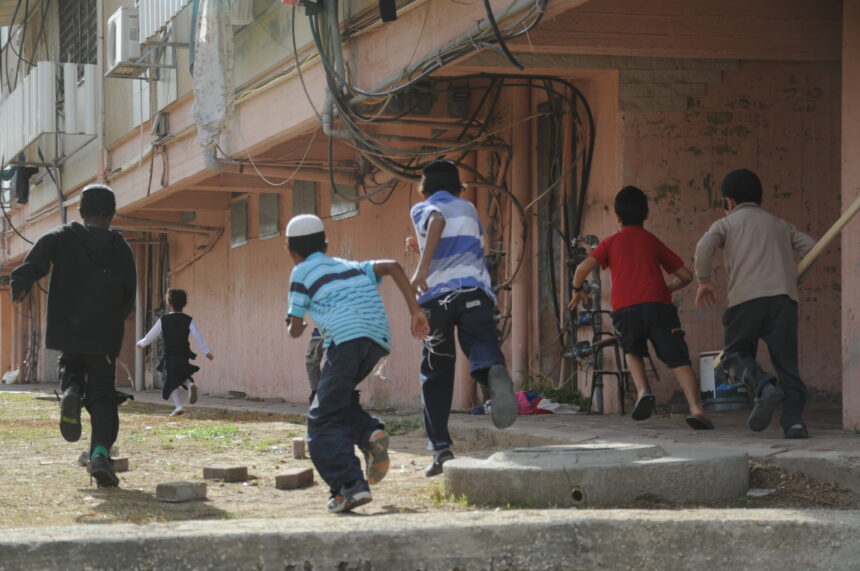
In the wake of recent security escalations, a specific defense has become the default shield for those who engage in the frantic, bone-breaking rush to bomb shelters: the halakhic mandate of V’nishmartem m’od l’nafshoteichem—the solemn command to “guard your souls exceedingly.”
On its surface, the argument is pious and unassailable. Who can argue against the Torah’s own directive to mitigate danger?
However, if we are to invoke the Divine mandate of life-preservation as a justification for our actions, we are bound by the laws of logic to apply that mandate consistently. To use V’nishmartem to justify a 90-second sprint while ignoring vastly greater daily lethality is not an act of piety; it is a selective application of a holy principle. We must ask ourselves if we are truly guarding our souls, or if we are merely performing a social ritual to avoid the stigma of appearing “reckless” or “lax” in the eyes of our neighbors.
The Mathematics of the Passive Risk
To understand the inconsistency, we must strip away the drama of the siren and look at the “passive risk”—the danger faced by an “innocent bystander” standing in a public space.
During the height of a conflict surge, an individual in an Israeli urban center faces a statistical probability of approximately 1 in 250,000 of being injured by shrapnel or blast force. This is a real risk, and the Torah certainly demands we address it. However, that same individual, walking down a typical city street on a “quiet” Tuesday afternoon, faces a 1 in 3,500 chance of being struck and injured by a motor vehicle.
If we are to be intellectually honest, we must acknowledge the multiplier. The car on the street is 71 times more likely to cause you physical harm than the missile in the sky.
If you are a pedestrian standing on a sidewalk in Bat Yam or Jerusalem, the bus passing two feet away from you represents a threat nearly eight times more lethal than an Iranian ballistic missile.
The Logical Reductio Ad Absurdum
If the principle of V’nishmartem truly compels you to engage in a panicked, high-speed dash because of a 1-in-250,000 risk, then what does that same principle demand of your daily commute?
If you were consistent, you could not merely “be careful” when crossing the street. If a 1-in-250,000 risk justifies a bone-breaking scramble to avoid looking “irresponsible” to the community, then a 1-in-3,500 risk—which is 71 times greater—demands an immediate and total retreat from civilization.
To be halakhically consistent with the logic of the “siren sprint,” one would be religiously obligated to move away from every city, town, or settlement where motor vehicles are found. You would be required to retreat to the wilderness, far from the reach of buses and cars, to mitigate a danger that is objectively more “present” than any rocket.
Yet, we do not see the “pious” runners selling their homes in Tel Aviv to live in the Samarian hills for the sake of road safety. We see them walk casually past buses and stand on curbs with normalized acceptance, only to lose their composure the moment the siren sounds.
Social Performance vs. Halakhic Duty
The discrepancy reveals a hard truth: the sprint to the shelter is often less about V’nishmartem and more about peer pressure. When the sirens blare, the eyes of the neighborhood are on the stairwell. To walk calmly is to risk being judged as apathetic, or worse, as someone who does not “value life.” The frantic run is a social signal—a way to “look good” by mirroring the panic of the crowd, thereby proving one’s adherence to the community’s (government mandated) standard of caution.
But the irony is that this social performance often leads to the very self-harm V’nishmartem prohibits. When Magen David Adom reports that scores of citizens are injured by falls and cardiac events while running to shelters—injuries that are statistically more frequent than those caused by the missiles—the “runner” is actually violating the Torah’s mandate. They are sacrificing their own and their children’s physical safety on the altar of social conformity.
A Call for Integrity
We must stop dressing our desire for social approval in the garb of halakhic necessity. If you run because you do not want to “look bad” or because you fear the judgment of your peers more than the logic of the statistics, admit that it is peer pressure. But do not claim it is V’nishmartem unless you are prepared to apply that same standard to the cars on your street.
Real Bitachon (trust) and real Hishtadlut (effort) require a calm, methodical assessment of reality. If we accept the 1-in-3,500 risk of the road as a background noise of life under Divine Providence, we are logically and religiously bound to treat the 1-in-250,000 risk of the sky with at least the same level of composure.
If you believe that safety is found merely by moving from point A to point B, then the “Slow Walk” is more than a safety protocol to avoid falling on a stairwell; it is an act of spiritual independence.
It is a testament to the fact that we serve the Creator, not the crowd.
If you believe the Almighty is the ultimate arbiter of life and death, then act like it—especially when the sirens blare and the world expects you to panic.

Thanks for this. The fact that more people are not harmed by the ballistic missiles is nothing short of miraculous. So maybe the statistics cannot be compared to other less miraculous situations such as walking down the street on a quiet afternoon. And, therefore, maybe the hishtadlus of entering a mamad is required regardless of the statistics.
Thank you for your comments. Is there such a thing as a “less miraculous situation,” especially when we have demonstrated that walking down the street requires absolute Divine protection?