


In the dense, sun-drenched urban dilapidation of central Israel, a statistical miracle is unfolding under the shadow of ballistic fire—one that has transformed the misery of missile bombardment into a sudden windfall for the nation’s most powerful real estate developers.
While the Iron Dome and Arrow systems allegedly maintain a staggering 90% interception rate, it is the 10% of Iranian missiles that manage to penetrate the defenses that have caught the eye of urban planners and alert residents alike.
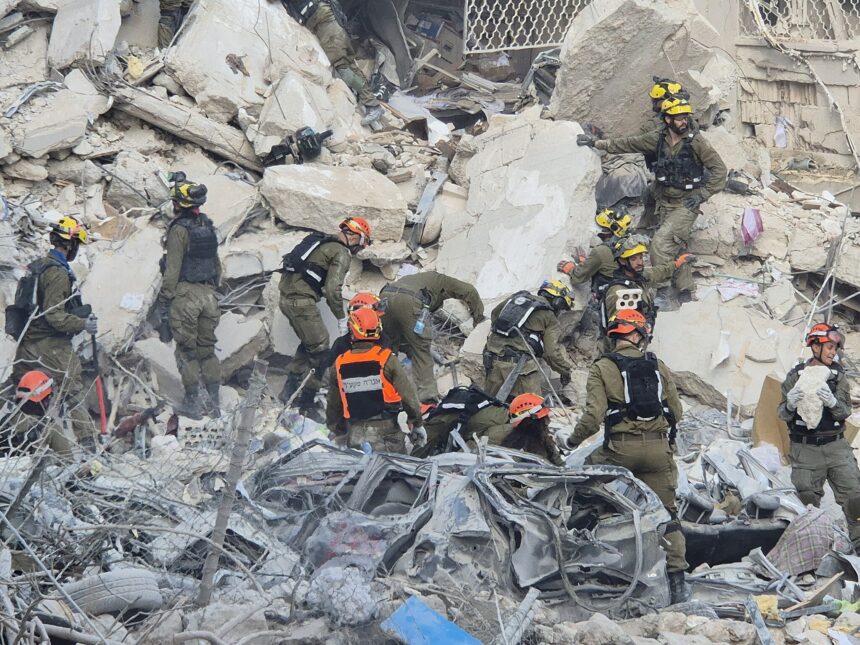
A spatial analysis of these impact zones reveals a pattern that has sparked a fierce national debate: the structures sustaining catastrophic damage—those immediately slated for rapid demolition and high-density redevelopment—are overwhelmingly pre-1980s residential blocks.
In a striking number of cases, these specific buildings were either already stalled in the bureaucratic pipeline for “Pinui Binui” renewal programs or were fast-tracked for luxury skyscraper development within weeks of being struck. This has occurred at a velocity entirely foreign to the traditionally glacial Israeli planning process.
This convergence of national security crises and private capital has fundamentally altered the landscape of Israeli urban development. The transition from localized rocket fire to state-on-state exchanges with the Islamic Republic of Iran, marked by “Operation Rising Lion” in June 2025 and the subsequent Operation Roaring Lion initiated in late February 2026, has introduced a lethal and highly efficient variable into the real estate market.
The Physics of Good Fortune
The official response from the State of Israel and the structural engineering community attributes these patterns to the cold logic of physics rather than selective defense or intentional targeting. Experts point to a “structural survivability bias” inherent in modern Israeli building codes.
Since the 1991 Gulf War, all new structures have been required by law to include a Mamad, or reinforced concrete safe room. In high-rise buildings, these safe rooms form a continuous vertical core anchored to the foundational bedrock.
When an Iranian warhead strikes a modern tower, these reinforced cores generally prevent a catastrophic collapse, even if the exterior facade is shredded. These buildings are repaired and returned to the market.
Conversely, the older “pillar buildings” lack these protective skeletons. They suffer total structural failure when subjected to the same ballistic variables. This creates a reality where only the oldest, most “renewal-ready” buildings are reduced to the kind of rubble that allows for immediate, high-density redevelopment.
Targeted Dividends: The Skeptic’s View
Official narratives emphasize defense and recovery, not exploitation, dismissing claims of intentional patterns as “sensationalism” or “misinformation.” They argue that impacts hit various sites—hospitals and refineries included—and that misses are simply the result of saturation attacks.
However, for a growing number of displaced families and urban activists, the “random impact” explanation is becoming harder to swallow. The skeptical view of “facilitated urban clearance” is bolstered by cases of impossible timing.
In Holon, Oron Real Estate found itself in the surreal position of having a missile strike execute a tenant evacuation, effectively resolving a process that could have otherwise taken years of litigation. In Ramat Gan, the Taharlev-Hamatmid complex had languished in planning purgatory for a decade, only to receive comprehensive municipal approval for a 60-story tower within weeks of a strike.
Public suspicion has been further inflamed by Finance Minister Bezalel Smotrich, who explicitly described conflict-related destruction as a “real estate bonanza.” While his remarks were officially directed at the future of Gaza, critics argue that this “capitalization via catastrophe” is being applied with equal vigor to high-value zones in central Israel.
A Law for the Lucky
The velocity of these post-strike approvals is a direct result of the state utilizing the crisis to dismantle decades of bureaucratic gridlock. Prior to the conflict, programs like TAMA 38 were frequently stalled by “holdout” tenants who refused to sign away their property rights.
The devastation of 2025 and 2026 provided the legislative opening the real estate lobby had sought for years. The “Law for the Rehabilitation of War Damage through Urban Renewal,” passed in late 2025, mandates that damaged older complexes be rebuilt through high-density projects rather than patchwork repairs.
Crucially, the law strips holdout tenants of their veto power by lowering signature thresholds. It also introduces a “buyout” mechanism that allows traumatized residents to sell their rights immediately to developers, often at a fraction of the future value of the site.
The Legal Anchor: Annexing the Neighborhood
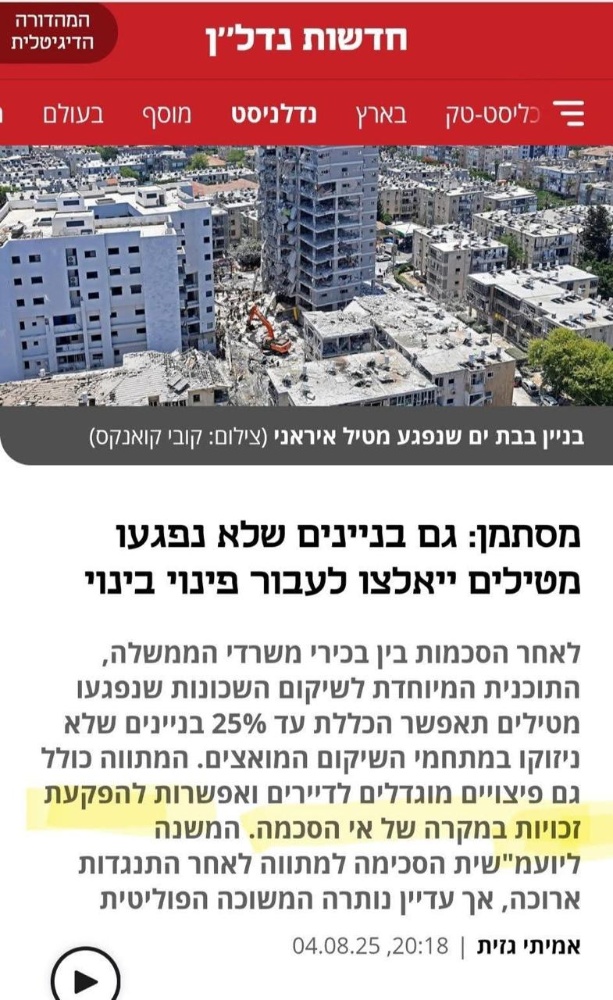
Perhaps the most aggressive feature of this legislative shift is a regulation that allows developers to include undamaged buildings in these fast-tracked renewal zones. By allowing up to 25% of structurally sound buildings to be annexed into a demolition site, the state has enabled the creation of massive, contiguous high-rise plots.
This essentially uses a single missile strike as a “legal anchor” to clear entire blocks of land that would otherwise be protected by property rights. This integration of emergency powers and private capital is further cemented by the “Rebuilding in Unity” program, which hands entire urban sectors to major contractors like Danya Cebus, managing the pipeline from the initial clearing of rubble to the final sale of luxury units. This convergence has effectively turned smoldering ruins into highly lucrative vertical assets in record time.
Ribbon-Cutting on the Rubble
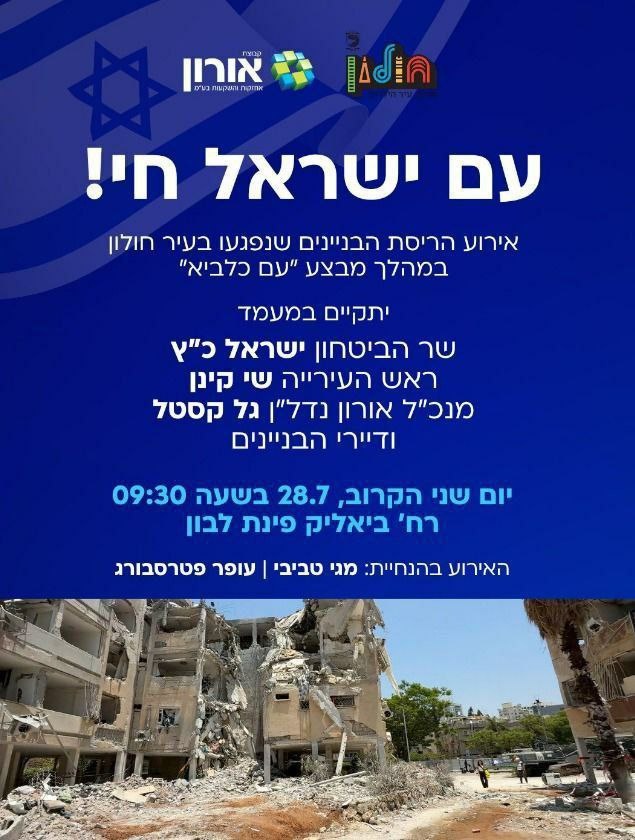
The human cost of this real estate metamorphosis was laid bare in Holon following a June 2025 strike at the corner of Bialik and Lavon streets. Weeks after the impact, the municipality organized a highly publicized demolition ceremony featuring Defense Minister Yisrael Katz and corporate executives.
The event, complete with professional emcees, framed the destruction of people’s homes as a “victory” milestone. Residents, many of whom were still living in temporary hotel rooms, reacted with fury, describing the polished event as a “PR show.”
To many, it appeared to be a literal manifestation of how Tel Aviv’s elites are toasting the end of the old order while residents mourn their history.
In Bat Yam, Maslawi Construction Ltd. proposed an “apartment swap” model that leverages the immediate humanitarian crisis. The developer offers traumatized residents keys to brand-new units in other parts of the country in exchange for the municipality transferring extensive future building rights for fortified towers on the bombed site.
The 10% Solution
The persistent debate over the policy of selective interception—where the military acknowledges optimizing resource allocation during protracted conflicts—remains a point of high social friction. Military officials have routinely admitted that a small percentage of missiles are allowed to “leak” through if they are predicted to impact areas that do not contain critical national infrastructure.
While no official data confirms that property values are factored into these air defense algorithms, the observable outcome—where these “leaks” repeatedly land on land held up by “holdout” tenants—has fueled a crisis of public trust.
The reluctance of municipalities to repair low-density structures guarantees a rapid vertical expansion, signaling the definitive end of minor structural reinforcements.
Whether by ballistic fluke or strategic design, the outcome remains the same: the physical and social scars of the war are being rapidly, and profitably, paved over with the next generation of Israeli high-rises.