



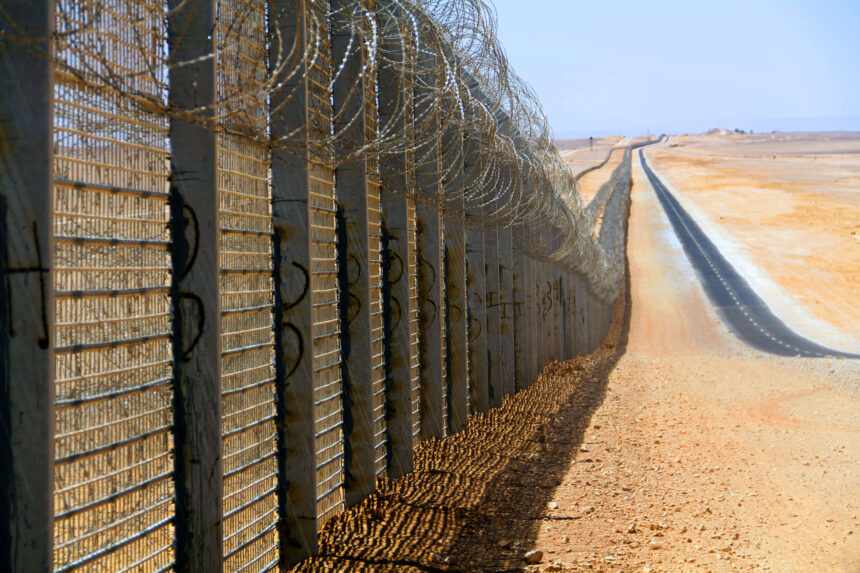
The State of Israel is mobilizing to construct a massive, multi-billion shekel defensive line along its 310-mile frontier with Jordan. On paper, the project is a long-overlooked necessity designed to seal the country’s porous eastern flank against a rising tide of Iranian arms smuggling.
But inside the closed briefing rooms where the strategic logic of the wall is being determined, a far more disturbing reality is taking shape. According to Jonathan Pollard, the military establishment is not merely building a physical barrier; they are reconstructing the exact psychological “conception” that collapsed on October 7.
In a series of recent meetings with the senior officers responsible for the new Eastern Defense Line (EDL), Pollard presented a critique of the project’s strategic vulnerabilities. He described the encounter as a terrifying glimpse into a security establishment that has learned nothing from recent history. While the engineers focus on concrete and sensors, the commanders’ strategic vision for pacifying the sector relies on a premise that Pollard characterizes as suicidal: the belief that economic incentives can buy security from a population committed to ideological warfare.
‘Economic Peace’ Delusion Again
When pressed by Pollard on how a fence alone could neutralize the “time bomb” of hostile terror cells growing within the terror nests of Jenin and Qalqilya—cities that sit directly behind the proposed line—the officers offered a solution that left the former analyst stunned. Their proposal to secure the central front was not military domination or demographic separation, but rather “more jobs for PA Arabs in Israel.”
Pollard characterized this response as a horrifying strategic blindness, comparing it directly to the policy of allowing suitcases of Qatari cash into Gaza in the years preceding the massacre. The belief that economic prosperity would sedate the genocidal ambitions of Hamas was the cornerstone of the intelligence failure in the south.
Now, Pollard warns, that same logic is being cut-and-pasted onto the eastern front. The officers, he argues, are attempting to bribe a population that is already heavily armed with smuggled weapons, effectively financing the very enemy the new fence is supposed to deter.
Wall Built on Sand
The danger is compounded by the assumption that the physical barrier itself will function as a hermetic seal. Pollard argues that this is a dangerous illusion, a “Sisyphean” trap that ignores the geopolitical reality of the region. The effectiveness of any border defense depends on cooperation from the other side, yet the Jordanian government has proven unwilling or unable to police its own territory. Pollard reports seeing trucks crossing from Jordan laden with heavy machine guns, Iranian anti-tank mines, sniper rifles, and mountains of grenades. For every truck intercepted, countless others slip through, feeding a terror swamp that the IDF refuses to drain.
The technological hubris that defines the project also draws Pollard’s ire. The reliance on anti-drone systems and sensors ignores the low-tech reality of the threat. The Jordanians have done nothing of significance to stop drone operators in their kingdom, and no electronic defense is 100% effective. By focusing on the hardware of the fence, the army is ignoring the software of the war: the hostile population residing in the territories that collectively represents a clear and present danger to the Jewish state.
Doctrine of Defense in Depth
To avoid a catastrophe, Pollard advocates for a doctrine of “Defense in Depth” that rejects the passive containment of the current general staff. He argues that a fence is useless unless the territory behind it is sterilized of threats. This would require a radical shift in policy, starting with a complete halt to vehicular traffic from Jordan and the restriction of Arab movement within the territories to strictly monitored buses. Furthermore, Pollard insists that the smuggling will only cease when the cost of participation becomes unbearable—advocating for heavy prison sentences for infiltrators and the deportation of their families to Syria.
Ultimately, however, Pollard’s assessment leads to a conclusion that the current defense establishment refuses to entertain. He argues that the multi-billion shekel frontier defense line is destined to fail for the same reason the Gaza barrier failed: a refusal to defend it aggressively on both sides of the line. Unless Israel is prepared to create an Arab-free defensive corridor along the Jordan Valley and transfer the hostile population that currently occupies the biblical heartland, the new wall will be nothing more than a monument to the same “Conceptzia” that has already cost Israel so dearly.


It’s not ‘strategic blindness’. It’s treason. Can’t anyone name truth for what it is?