


In the cold arithmetic of covert operations, there is no asset more valuable than a crisis that cannot be solved. Solved crises lead to inquiries, elections, and accountability. Unsolved crises, however, create a state of suspended reality where the impossible becomes necessary.
In the 1980s, the Reagan administration faced a legal blockade: Congress had forbidden the funding of the Contras in Nicaragua. To bypass the law, the National Security Council created a shadow economy. They sold arms to a sworn enemy (Iran) and used the proceeds to fund the Contras. But how could they justify selling missiles to the Ayatollah? They needed a cover story so compelling that it would silence all moral and legal objections.
They found it in the American hostages held in Lebanon.
Secretary of State George Shultz later called it a “hostage bazaar.” The hostages were not the target of the policy; they were the currency. Their captivity was the moral shield that allowed the “Enterprise” to operate above the law.
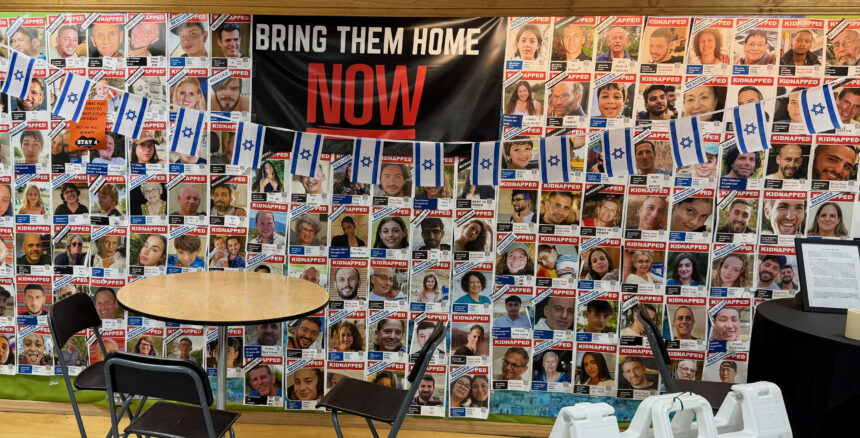
Today, Israel is trapped in its own Hostage Bazaar. And just like in 1986, the captives are being used to purchase a political outcome that the public would never otherwise accept.
The Economy of Managed Panic
We previously reported on the concept of “Managed Panic“—the strategic use of fear to herd a population toward a pre-determined destination. Nowhere is this more evident than in the “negotiations” for the hostages in Gaza.
From a forensic standpoint, the conduct of the war contradicts the stated goal of “Total Victory.” If the objective were truly the eradication of Hamas, the supply lines of fuel, flour, and Qatari cash would have been severed on Day One. Instead, they have been maintained, even protected. Why?
The answer lies in the “rationing” of the release. In the Iran-Contra dynamic, hostages were released in small batches—just enough to prove the “channel” was working, but never enough to end the crisis. This kept the arms flowing. In Gaza, we see a similar, ghastly calculus. The releases are timed not to empty the tunnels, but to manage the pressure on the Israeli street.
The moment the last hostage returns, the war loses its primary emotional engine, and the government loses its immunity from the reckoning that awaits. The public would demand immediate elections, and the government would fall. Conversely, if the hostages were declared lost, the grief would turn into a rage that would demand a “Masada” option—a total conquest of Gaza that the U.S. administration explicitly forbids.
To maintain the US-Saudi-Israel alignment, the crisis must be kept in the “Goldilocks” zone: tragic enough to justify American intervention, but hopeful enough to keep the Israeli public compliant.
The Purchase: A ‘Revitalized’ Trap
What is being bought with this currency?
The U.S. administration has been transparent about its endgame: a “Revitalized Palestinian Authority” governing Gaza, leading to a Palestinian State and normalization with Saudi Arabia.
For the Israeli right-wing majority, this is anathema. It is a strategic defeat. Under normal circumstances, any Prime Minister who proposed bringing the PA back into Gaza would be removed from office.
But these are not normal circumstances. By linking the Saudi Deal and the PA Restoration to the Hostage Deal, the architects of this policy created a trap. The narrative was shifted: “The only way to save the hostages is to accept the Regional Deal.”
The hostages were the leverage used to force the Israeli public to swallow the poison pill of Palestinian statehood. The logic is brutal: You want your children back? Then you must sign the death warrant of your sovereignty.
The Forensics of Betrayal
Just as the Typewriter Ribbon eventually unraveled the lies of the Pollard affair, the forensic evidence of the Hostage Bazaar is visible in the contradictions:
- The Aid Paradox: We are feeding the enemy holding our children. This is militarily insane, but politically essential if the goal is a “managed” conflict rather than a victory.
- The “Day After” Silence: The refusal to articulate a “Day After” plan is not indecision; it is concealment. The plan is already agreed upon; it is simply too toxic to unveil until the public is sufficiently broken.
- The Doha Immunity: Even after the elimination of Yahya Sinwar, the negotiations continued seamlessly through the “Doha Group” led by Khalil al-Hayya. The fact that the “mediator” (Qatar) hosts the command structure of the enemy without consequence proves that the “bazaar” is protected. The business of trading lives must go on, regardless of who is killed in the tunnels.
In the Hostage Bazaar, the currency is human suffering, but the product being sold is a new Middle East Order—one where Israel is no longer a sovereign state, but a dependent protectorate.
The hostages were never just captives of Hamas; they are prisoners of a geopolitical script. And until we refuse to pay the price, the bazaar will remain open.