



Prime Minister Binyamin Netanyahu’s career is defined by a central paradox. He is the ultimate “Mr. Security,” a leader of hardline rhetoric and vows of “total victory.” Yet, his political history is a trail of stunning concessions, from the Hebron Accords to the current, grinding war in Gaza.
This contradiction is often explained as pragmatism. But another, less-examined framework suggests these are not compromises, but the consistent execution of a “no-win” doctrine—a policy of managed conflict designed not to defeat enemies, but to maintain a permanent “equilibrium.”
This is the playbook of an elite, bipartisan U.S. foreign policy establishment, crystallized in the organization that has shaped it for a century: the Council on Foreign Relations (CFR).
The Architects of Equilibrium
Founded in 1919 by American intellectuals and diplomats disillusioned by the U.S. rejection of the League of Nations, the CFR’s quiet, long-term mission was to guide America’s role in the world. Its influence became stated doctrine after World War II. As the Cold War began, CFR-affiliated figures like John Foster Dulles and Arthur Schlesinger Jr. architected the West’s grand strategy.
This strategy, known as “containment,” was not about defeating communism. It was about arranging an “equilibrium of forces.” The goal was stalemate, not sovereignty. The “obsolete prerogatives” of allied nations—such as their right to pursue unconditional victory—were often seen as secondary to the stability of the global system.
In practice, this meant agreeing to partitions in places like Korea and Vietnam. The “stalemates” in those countries were not accidents; they were the goal. They created unending division and simmering, low-level conflict, but they prevented a decisive outcome that could upset the global balance.
A Bipartisan Doctrine
This doctrine was always bipartisan, and its persistence is the key. One need only look at the Republican “America First” administration of Donald Trump (2025-present). While President Trump himself is not a member, his foreign policy and national security apparatus includes key figures with CFR affiliations: Treasury Secretary Scott Bessent, Director of National Intelligence Tulsi Gabbard, and Defense Secretary Pete Hegseth.
Their policy for Gaza, formalized in the Trump-brokered ceasefire deal, is the very picture of this historic, multilateral globalism. An October 24, 2025, Washington Post report details the intense U.S. enforcement of this “no-win” pact. A “flurry of visits” from U.S. officials—including VP JD Vance, Jared Kushner, and Secretary of State Marco Rubio—has been dubbed “Bibi-sitting” by Israeli media, openly mocking Netanyahu’s loss of “freedom of action.”
Rubio, in Jerusalem, laid the doctrine bare, warning that this ceasefire is the “only plan” and there is “no plan B.” His words confirm the U.S. commitment is not to Israel’s victory, but to a “demilitarized Gaza” managed by “over two dozen countries, including regional Arab countries.”
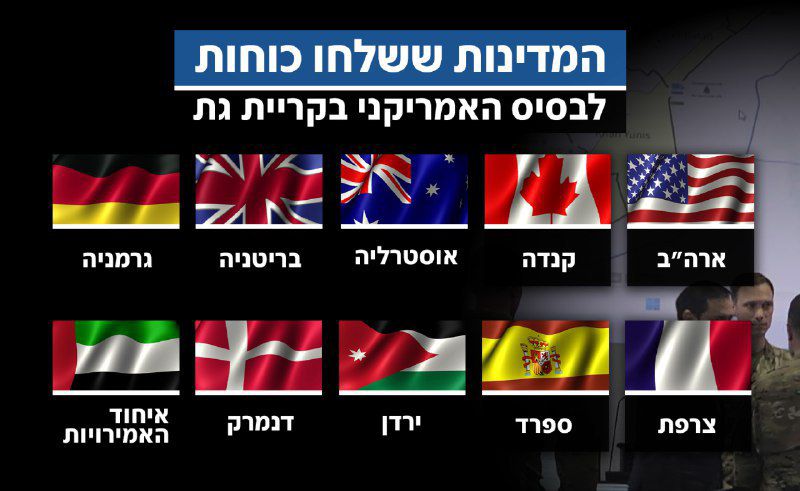
The true U.S. priority was exposed when Netanyahu’s coalition partners pushed a symbolic annexation vote for Judea and Samaria. The U.S. reaction was not just disagreement; it was a threat. Vance called it a “very stupid political stunt,” and Trump himself stated that if Israel proceeded, it “would lose all of its support from the United States” because he “gave his word to the Arab countries.”
This is the globalist doctrine in its rawest form: Israel’s “obsolete prerogative”—its sovereignty over its biblical heartland—is being explicitly sacrificed for a larger regional “equilibrium” (the “word to the Arab countries”). The plan’s next phase, as detailed by Kushner, involves starting reconstruction only in the 50% of Gaza Israel controls, to “create a dynamic.” This is not a plan for victory; it is the literal partition of Korea and the “neutralism” of Vietnam reborn in the Middle East.
October 7 and the ‘Total Victory’ Mirage
This 60-year-old doctrine finds its echo in the sands of Gaza. Following the horrific Hamas-led attack on October 7, 2023, Netanyahu promised “total victory” and the “eradication of Hamas.”
Two years later, as of October 2025, that victory is a mirage. While the IDF has achieved tactical dominance over 75 percent of the Gaza Strip, Hamas has not been eradicated. It has adapted, surviving amid the chaos of a displaced population.
Confronted with this reality, Prime Minister Netanyahu on October 26 furiously slammed critics, insisting that “We are in control of our security” and “we will continue to control our destiny.” This is not the confident statement of a leader, but the desperate deflection of a man whose long-held, hidden script is being exposed.
As a truth begins to dawn on the nation—that the “no-win” war is a feature, not a bug—the rhetoric must become more shrill. These words appear to be a performance, completely detached from the policy his government is actively negotiating. While he speaks of victory, his government accepts U.S.-pressured ceasefires that allow Hamas to regroup and engages with the very “multilateral reconstruction” plans that guarantee his stated war aims will fail.
A Pattern of Abandoned Red Lines
This contradiction is Netanyahu’s signature. To understand his actions in Gaza, one must look back to the Wye Plantation Summit in 1998. Netanyahu arrived with firm “red lines,” including no release of prisoners with “blood on their hands” and, most emotionally, a vow that he would not leave without securing the freedom of Jonathan Pollard.
After nine days of intense U.S. pressure, he signed the memorandum. He ceded 13 percent of Judea and Samaria and released Palestinian prisoners, but Jonathan Pollard remained in an American prison for another 17 years.
This was not simply pragmatism; it was a clear demonstration of the doctrine. National “red lines” and “obsolete prerogatives”—like freeing a national hero or refusing to cede land—were sacrificed for the “equilibrium” of the peace process, managed by U.S. negotiators steeped in the CFR framework. The system, not the leader, dictated the outcome.
Championing the ‘Managed’ Solution
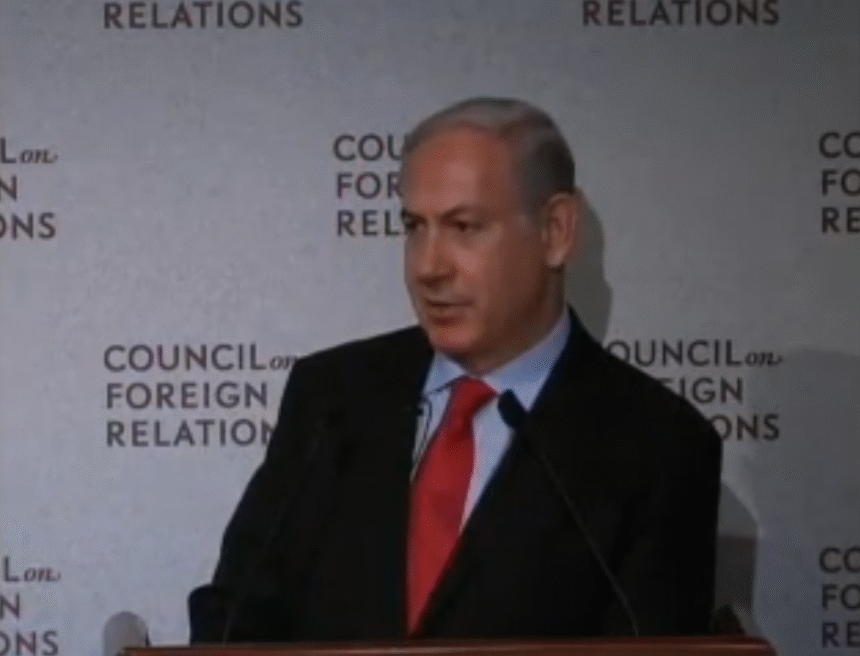
This performance of caving to the system was not an anomaly; it was a prelude to him publicly championing it. Any claim that Netanyahu is a nationalist resisting globalist pressure crumbles against his own words, delivered at, of all places, a 2010 Council on Foreign Relations event.
Speaking directly to the architects of the “managed conflict” doctrine, Netanyahu articulated the very “solution” he now pretends to oppose. “The substance of my… peace is a solution of two states for two peoples,” he told the CFR audience, “in which a de-militarized Palestinian state recognizes the Jewish state of Israel.” This is the doctrine in its purest form: “de-militarized” is the illusion of security, the definition of a “managed” outcome that undermines Israel’s safety while denying its sovereignty.
When a CFR member pressed him on how he would get domestic political support to implement this vision, specifically regarding the removal of Jewish communities, Netanyahu confirmed his strategy. He spoke of defining a “clear vision” so people would see the “benefits,” and, most revealingly, of using “the dimension of time as a crucial element for implementation.”
This was not the answer of a leader beholden to his people; it was the chillingly laconic answer of a manager. He was signaling to the globalists that he understood their long-term project and was prepared to see it through, waiting for the right moment—or the right crisis—to finally execute the plan.
The Mideast Union Trap
For decades, the public has been handed individual policy “pieces,” each appearing as an innocent, safe, and familiar-looking step: a “peace process,” a “humanitarian pause,” a “two-state solution,” a “ceasefire,” an “international stabilization force.”
But this is not a pathway to peace. It is the construction of a trap, and the “managed” chaos in Gaza is not the endgame; it is the brutal initiation fee.


The true, unspoken goal of this entire globalist machination is not merely a Palestinian state. That is simply the price of admission. The real prize is the creation of a “Mideast Union,” a new regional bloc modeled after the European Union, managed by the same globalist architects and financially dominated by Saudi Arabia.
In this new order, Israel is being forced to play a specific, tragic role: the muscle. Israel is shedding blood, suffering catastrophic losses, and absorbing the world’s condemnation, all to dismantle regional threats that stand in the way of Saudi and American regional interests. Israel is fighting for Saudi Arabia’s strategic future.
The Abraham Accords, sold as an historic peace, are now revealed as the diplomatic vehicle for this forced integration. The “revitalized” Palestinian Authority, planted not just in Gaza but in the heart of Judea and Samaria, is the non-negotiable sacrifice required for Israel to be “normalized” into this new bloc.
This is the final, deliberate betrayal. The “total victory” that was promised is being traded for a “total integration,” where Israel’s sovereignty is dissolved. It ceases to be a nation that “makes its own decisions” and becomes a province in a new, Saudi-led order, having paid for its own chains with the blood of its own soldiers.


I think you have identified the problem. Israel has been swallowed by the globalist blob that is the CFR.
Now that you’ve mentioned the CFR, are you going to discuss how Bibi was listed by them as a member in 1989, as one could see in documents published by Barry Chamish?
And you don’t discuss what was in it for Bibi to join, or in your case, to go along with the CFR.
Joining them provided him with guaranteed success as long as he played their game. And he has played it for them. Kissinger was his handler.