


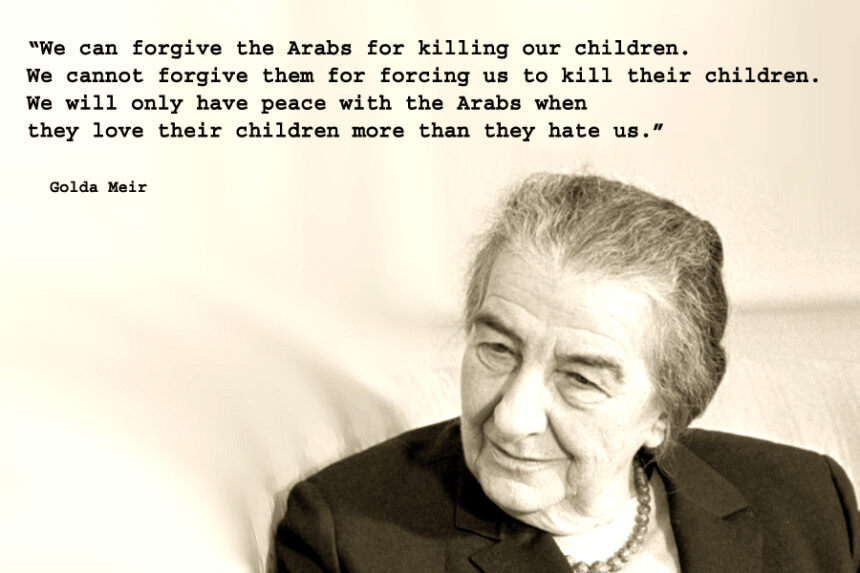
In the summer of 1969, with the echoes of the Six-Day War still reverberating and the grinding War of Attrition underway, Israeli Prime Minister Golda Meir stood before a press conference in London and uttered a phrase that would echo for half a century. “We can forgive the Arabs for killing our sons,” she declared, her voice heavy with the supposed weight of a tragic destiny. “But we cannot forgive them for forcing us to kill their sons.”
In that moment, a powerful and enduring myth was forged. The statement was seized upon as the ultimate expression of Israeli humanism, a testament to a nation so morally advanced that it felt the pain of its enemies’ losses more acutely than its own. It became a cornerstone of the nation’s public diplomacy, a shield of enlightened sorrow to be held up against any accusation of aggression.
But this celebrated quote, when held up to the clarifying light of authentic Jewish values and the brutal calculus of survival, is not a statement of moral strength. It is the ideological blueprint for a national suicide pact. It represents a profound inversion of the most foundational principle of Jewish life: its supreme and overriding sanctity.
Beneath the veneer of enlightened compassion lies a political psyche dangerously preoccupied with the judgment of its enemies and the fickle approval of a watching world, a psyche that has forgotten its most sacred and primary duty: to protect its own children, first and always.
This sentiment, blithely uttered in a London press hall, did not remain a mere sound bite. It has metastasized over the decades, seeping from the realm of rhetoric into the very bloodstream of the state, ultimately shaping the Israel Defense Forces’ rules of engagement into a doctrine of self-restraint so profound it borders on self-immolation.
A Foreign Morality
The intellectual and spiritual roots of this flawed morality run deep, back to the very creation of the modern Jewish state. While the founders of secular Zionism have been portrayed as complex figures, driven by a desire for “freedom from religion,” money, and power, their followers, the wretched masses, were driven by a desperate need to solve the existential crisis of Jewish homelessness and persecution.
Yet, in their quest to build a new nation, they were often at war with the very nation they sought to save. They envisioned a “new Jew,” a figure liberated from the perceived weakness of the Diaspora, but also a citizen of the world, a member in good standing of the “family of nations.” This created an immediate and irreconcilable tension between the irreplaceable specialness of Jewish identity and a yearning for universal acceptance. In their effort to be accepted, they grafted a foreign moral framework onto the new state—a framework derived largely from a Christian, Western humanism that was often diametrically opposed to Jewish law on warfare, self-preservation, and national obligation.
This led to a tragic paradox. The state, which was touted as the ultimate guarantor of Jewish safety, adopted a Machiavellian posture that turned its strategic logic inward. It became more concerned with managing its image than with defeating its enemies. The core mission of a Jewish state—to be unapologetically Jewish and to prioritize Jewish life—was subtly replaced by a universalist creed that intentionally blurred the distinction between our children and theirs. This secular betrayal of Zionism’s original promise has had devastating consequences, creating a state that possesses immense power but is often psychologically unwilling to wield it decisively for its own preservation.
The Jew Shall Turn the Other Cheek
Nowhere is this doctrinal crisis more apparent than on the battlefield. The IDF’s operational conduct is now governed by a modern-day echo of Molech, the ancient Canaanite deity to whom children were sacrificed to appease a foreign god.
Today, the foreign gods are international opinion, the Hague, and the editorial pages of Western newspapers.
The sacrifice demanded is the blood of our own soldiers, offered up on the altar of “proportionality” and a distorted notion of “purity of arms.” When the IDF drops a low-impact missile on the roof of a building filled with munitions and enemy combatants—a practice known as “roof knocking”—it is not a sign of moral superiority. It is a direct warning to the enemy, giving them time to escape and regroup, an act of military insanity that places the lives of those who seek to kill us above the lives of the soldiers sent to eliminate the threat to our lives.
When an Israeli soldier, sighting a terrorist armed with an anti-tank missile, hesitates to fire because of a nearby individual whose “non-combatant” status is uncertain, he is not upholding a Jewish value. He is enacting Golda’s formula. He is subordinating his life, and the lives of his brothers in arms, to the life of the enemy’s son.
This is a perverse and deadly competition to outdo the Christian ideal of “turning the other cheek,” a race to the moral high ground that has only one destination: the cemetery. The concept of Tohar HaNeshek, or purity of arms, has been unmasked of its purported meaning—a warrior’s responsibility to avoid wanton cruelty—to reveal an absolute, paralyzing commandment that actively endangers Jewish lives.
How to Embolden an Enemy
This strategic sickness functions like a political thalidomide, a policy prescribed as righteous and humane that results in crippling, degenerative consequences for the body politic. The doctrine of extreme restraint does not win Israel friends, nor does it deter its enemies. It does the opposite. It emboldens them.
Adversaries from Hamas to Hezbollah have studied this pathology and learned to exploit it with lethal precision. They understand that using their own population as human shields is not a moral failing in the eyes of the world, but a brilliant strategy that leverages Israel’s self-imposed moral handcuffs against it. The more they embed their operations within civilian areas, the more they benefit from Israel’s reluctance to act, a reluctance born from the fear of condemnation.
This is a deliberate corruption of strategic reality, where the clear and present danger to the state is willfully ignored in favor of maintaining a politically convenient but demonstrably false moral narrative. The belief that this restraint will one day be rewarded with understanding or peace is a dangerous fantasy. It is a policy that guarantees perpetual conflict by signaling to the enemy that their tactics are effective and will be met with a hesitant, self-doubting response. It is a public declaration that the lives of our soldiers are a resource to be expended in the service of public relations.
Israel’s Ghetto Mentality
This deep-seated reluctance to wield power with conviction is a ghost of the past, the psychological scar of two thousand years of Diaspora existence. The historical record is replete with examples of a tragic Jewish failure to recognize mortal threats and act upon them, a pattern born from the powerless position of a minority dependent on the whims of a host nation.
This psyche, terrified of being perceived as the oppressor, has been tragically imported into the halls of power of a sovereign state. The fear of becoming “like them”—like the Cossacks, the Inquisitors, the Nazis—has led to a catastrophic failure to understand that the greatest moral evil is to allow Jewish blood to be spilled when one has the power to prevent it. Applying the political calculus of a defenseless minority to a modern nation-state with a powerful army is a recipe for disaster.
Moral Recalibration
To survive and to fulfill its purpose, Israel must unapologetically reject Golda’s formulation and the suicidal morality it has spawned.
It is time to restore the correct Torah perspective, a perspective that is not cruel, but sane. It is time to state the truth without flinching, to recalibrate the nation’s moral compass away from the magnetic north of universalist approval and toward the fixed star of Jewish survival.
The path to genuine peace requires an honest declaration, free from the need for external validation. It is a formula that understands that while we can perhaps find it in ourselves to forgive our enemies for forcing us into the necessary act of killing their children, we can never, under any circumstances, forgive them for killing our own.
A lasting peace will only become possible when it is understood, by all, that we will always love our children more than they love theirs. This is not a call for brutality, but for clarity. It is an affirmation that the primary moral duty of a Jewish state is to the Jewish people, and a declaration that the lives of its soldiers are infinitely more valuable than the lives of those who seek to destroy them.
True peace will come not when Israel proves its moral superiority to a hostile world, but when its enemies understand, without a shadow of a doubt, that the Jewish nation values the lives of its own children above all else.

Very good article! I do agree.