



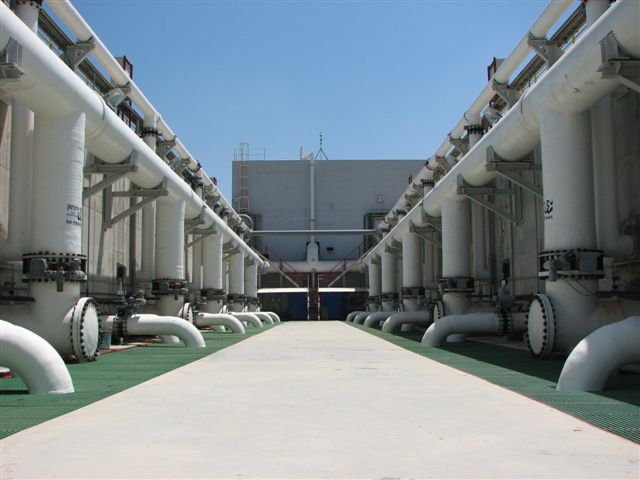
For more than two decades, the hum of industrial pumps along Israel’s Mediterranean coast stood as a monument to human engineering over nature. In a bone-dry region defined by Biblical droughts and geopolitical water wars, six massive desalination plants had promised something once thought impossible: complete immunity from the weather.
Then, over a single weekend, the machines went quiet.
First came the shutdown of the massive southern plant in Ashkelon. By Monday, four more facilities stretching north had halted operations. Together, the offline plants accounted for roughly 80 percent of the nation’s domestic seawater processing capacity.
In response, government officials offered a swift, tidy explanation: a sudden surge of microscopic algae, carried by currents from Egypt’s Nile Delta, had fouled the coastal intake waters. The sea had become too murky for delicate reverse-osmosis filtration membranes to handle. Simultaneously, officials moved with unusual speed to quash whispers of a foreign cyberattack—a persistent fear after a summer of Iranian probes targeting Western municipal infrastructure.
Yet an examination of the shutdown reveals a troubling gap between the government’s public assurances and the verifiable evidence on the ground.
State agencies announced the cause before releasing a single laboratory cell count, turbidity log, or public satellite map. More critically, the crisis has exposed the fragility of a national ethos built on the promise that technology had forever conquered natural scarcity—raising sharp questions about whether a temporary marine anomaly is being used to usher in an era of permanent water rationing.
Israel’s Mediterranean Desalination Grid
- 🟢 Hadera: Operational (Northern coast)
- 🔴 Palmachim: Shut Down
- 🔴 Sorek 1 & 2: Shut Down (Nation’s largest facility)
- 🔴 Ashdod: Shut Down
- 🔴 Ashkelon: Shut Down (Southernmost facility)
The Anatomy of a Rapid Response
The timeline of official messaging moved far faster than the scientific validation.
When the state Water Authority finally acknowledged the shutdowns to the general public, plant operators had already been taking units offline for nearly 48 hours. By the time the news broke in the Israeli and international press, the official conclusion was already embedded in headlines: Not a cyberattack.
Only hours later did the government offer an environmental culprit. In a live media briefing, Alon Zask, director general of the state-run Israel Oceanographic and Limnological Research (IOLR) institute, stated that a northern-drifting algal bloom “appeared to be” the culprit. He noted that Hadera, the lone northern plant that stayed online, likely escaped because coastal currents behaved differently there.
It was a working hypothesis from a government scientist, not a lab sheet. No species name, no cell count, no hourly intake log, and no satellite image was released with the quote. Zask’s institute said it had looked at satellite data. The public was not shown the map.
| Official Claim | What Has Been Made Public |
|---|---|
| Algal bloom from the Nile | No species ID, cell counts, or raw intake logs |
| Satellite verification | No public satellite or turbidity heatmaps |
| “Not a cyber incident” | Single unnamed source quote; no audit logs |
| Hadera spared by currents | No published intake chemistry differentials |
To environmental scientists and forensic analysts, the explanation arrived with notable omissions:
- No Species Identification: The Water Authority did not publish the biological taxonomy or density measurements of the alleged algae.
- Missing Intake Chemistry: Hourly silt-density and turbidity readings from individual plant intake manifolds were kept behind closed doors.
- Unreleased Imagery: While state scientists cited satellite data, raw thermal or chlorophyll-a imaging showing the plume’s trajectory along the Gaza and Israeli coastline was not published for independent review.
Meanwhile, the cyber denial rested on a single unnamed industry source and boilerplate language from the National Cyber Directorate noting that routine Iranian network probes had caused no damage.
For newsrooms accustomed to covering Israeli security and infrastructure, the choreography was familiar: neutralise panic over an enemy attack immediately, allow state scientists to offer a plausible environmental hypothesis, and leave environmental NGOs to debate policy implications.
The issue is not whether algae can clog a membrane—it certainly can. The issue is that when five critical national assets shut down simultaneously, the public deserves forensic data, not a narrated conclusion.
The Broken Promise of ‘Weather Independence’
To understand the political stakes of the shutdown, one must understand how deeply desalination is woven into Israel’s modern identity.
For decades, the country lived under the shadow of the red line on the Sea of Galilee, the freshwater lake whose falling waterline was once broadcast on the nightly news like a national fever chart. But through billions of dollars in private-public partnerships, Israel built what many considered the world’s most advanced desalination network.
Evolution of Israeli Water Independence
Cloud-Seeding Programs
Decades of artificial rainmaking experiments (Israel I–IV) finally abandoned after data proved negligible statistical impact.
Mega-Desalination Plants
Taps declared decoupled from rainfall; pure seawater pumped into national grid and Galilee reserves.
The system was marketed as a total divorce from the atmosphere. Successive prime ministers boasted that rainfall no longer dictated the Israeli lifestyle. By earlier this year, desalinated water was even being pumped back into the Sea of Galilee to replenish nature. The cabinet approved a 50-year master plan to construct new mega-facilities, and tenders for another plant were advanced just days before the crisis.
The reliance on “weather” to explain the recent collapse carries a bitter historical irony.
For nearly 60 years, the Water Authority funded expensive cloud-seeding initiatives (the “Israel I through IV” experiments) in a bid to force rain from the sky. When Tel Aviv University scientists and independent reviews proved that the seeding had virtually zero statistical impact on rainfall, the state abandoned atmospheric modification and bet everything on seaside reverse-osmosis machines.
Now, the agency has returned to the very word it claimed to have mastered: the weather.
If an ordinary seasonal current and an algal bloom can knock out four-fifths of the country’s coastal water processing in a weekend, the promise of total technological immunity was, at best, incomplete. At worst, it reveals a system vulnerable to the very environmental shocks it was built to ignore.
Rationing in the Desert: Who Bears the Cost?
While urban apartment towers in Tel Aviv experienced little more than shut-off beach showers and minor drops in water pressure, the real pain of the shutdown was redirected south—far from city voters.
In Givatayim as well as the Binyamin Regional Council, the municipalities went further. Residents were told disruptions were possible in the coming hours — lower pressure, even outages in some streets — and were asked to use water “only for essential needs until normal operations resume.”
In Pit’hat Nitzana, in Ramat Negev near the Egyptian border, the hit was immediate. Growers there take 80 to 90 percent of their water from the national desalinated supply. About 20,000 dunams of winter vegetables — tomatoes, peppers, cucumbers, eggplant — had just gone into the ground. They needed roughly 1,500 cubic meters an hour. Mekorot was sending 300 to 500.
Ramat Negev Crop Water Allocation (Hourly)
“Growers were in the middle of seeding,” Eran Doron, head of the Ramat Negev Regional Council, told local business media. “They needed 1,500 cubic meters an hour. They were given 300 to 500. You cannot postpone irrigation when young crops are in the dirt.”
The rationing was not ad-hoc; it relied on statutory allocation frameworks already laid out for future seasons. In public administration, emergency cuts almost always follow the path of least political resistance: first, public fountains and decorative parks; next, commercial growers; and only last, the kitchen sinks of residential voters.
The disparity has fueled suspicions among agricultural leaders that the crisis is being used to accustom the public to a new normal: structural scarcity, centralized control, and permanent belt-tightening.
The Doctrine of ‘Water Bankruptcy’
The shutdown coincides with a broader shift in global water policy. In international hydrologic circles, experts have increasingly warned that treating water as an infinite engineering commodity is unsustainable.
In a landmark report published by the United Nations University Institute for Water, Environment and Health, water scientist Kaveh Madani coined the term “Global Water Bankruptcy.” Madani argued that modern societies must stop treating dry spells as temporary “crises” with easy engineering fixes. Instead, they must treat basins as overdrawn bank accounts requiring strict, permanent bankruptcy management: enforced withdrawal caps, realistic consumption limits, and aggressive demand management.
The Shift in Global Water Management Doctrine
The Old Model: Supply Expansion
- Build larger mega-plants
- Promote endless supply decoupling
- Treat nature as an engineering hurdle
- Subsidize high municipal consumption
The New Model: Water Bankruptcy
- Enforce strict statutory user caps
- Acknowledge ecological intake limits
- Prioritize demand reduction
- Condition public for structural austerity
In Israel, that transition is already underway behind closed doors. Environmental advocacy groups like Adam Teva V’Din and EcoPeace Middle East immediately seized on the shutdown to argue that over-reliance on desalination had created a dangerous illusion of abundance, distracting from deteriorating natural aquifers and untreated regional wastewater.
When officials use an unexpected weekend shutdown to urge public conservation, they are operating within this new paradigm. A sudden shock can achieve in 72 hours what years of government white papers could not: convincing a skeptical public that the taps cannot be taken for granted.
What Needs to Be Disclosed
To determine whether the five-plant shutdown was an unavoidable natural disaster or a failure of operational transparency, researchers and consumer advocates say several key pieces of evidence must be made public:
The Transparency Checklist
◻ SATELLITE PLUME DATA
Release Copernicus Sentinel-3 chlorophyll and turbidity maps tracking the Nile Delta plume from Aug. 29–31.
◻ INTAKE LABORATORY READINGS
Publish hourly Silt Density Index (SDI), nephelometric turbidity, and species counts for Ashkelon, Ashdod, Palmachim, and Sorek.
◻ CONTROL SYSTEM AUDITS
Independent verification of SCADA industrial control logs to rule out software, cyber, or electrical tripping mechanisms.
◻ RESTART BENCHMARKS
Demonstrate that plants returned online strictly as feedwater chemistry cleared, rather than on an arbitrary political schedule.
◻ FINANCIAL FORCE-MAJEURE FILINGS
Disclose whether private plant consortiums are claiming state indemnities or contractual exemptions for lost output.
A Question of Sovereignty and Truth
In this arid corner of the Mediterranean, water has never been just a utility; it is a foundational pillar of national sovereignty. In the pre-state era, strict limits on water supply were used by British authorities to argue that the land could not absorb new populations. The modern state responded by pioneering drip irrigation, wastewater recycling, and ultimately, ocean desalination.
To see that technological fortress suddenly shuttered—and replaced with warnings to conserve and cut back—is more than an operational hiccup. It strikes at the core of a national narrative.
An algal bloom may well have stirred the sea this week. Citizens can prefer that account after the maps and the logs are public — and after it is clear whether the cuts die with the murk or stay, renamed as maturity. They are entitled to measurements, not to a headline that knew the ending before it had a cause.
In a country that built its future on the mastery of water, citizens are entitled to demand hard data over convenient narratives—and to ensure that a weekend of murky waves does not become the pretext for a permanent regime of managed scarcity.