



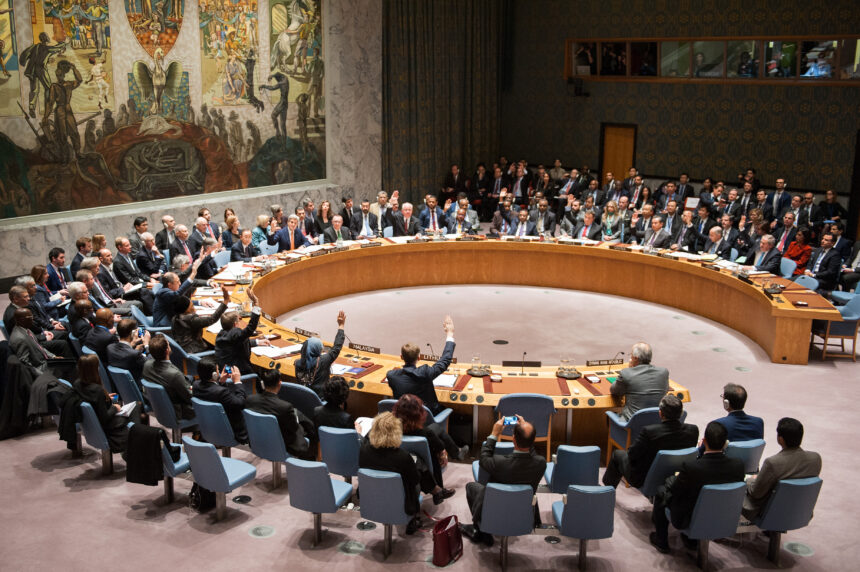
In the days of Asaph the Seer, the nations formed a confederacy — Edom, Ishmaelites, Moab, Ammon, Amalek, Philistines, Tyre, and the children of Lot backed by Assyria — and plotted with one mind against the G-d of Israel and against His people.
Their goal was not mere defeat, but erasure: the complete removal of Israel’s name from the earth.
That ancient “crafty counsel” (Psalm 83:3) did not end in the days of ancient Israel. A remarkable series of five essays by David Moshe ben Avraham, published this month, demonstrates with exhaustive historical documentation and scriptural precision that the same coalition spirit operates today — through Western intelligence services, imported Islamist ideology, and the theological architectures of both Christian and Islamic supersessionism.
However, as the series notes, this “crafty counsel” is often more subtle than a smoke-filled room of conspirators. It is better understood as institutional muscle memory — the inherited reflexes of bureaucracies and civilizations built on the premise that the Jewish story was finished.
The essays — The Theology That Lost Its Timeline, The Guardian Who Contradicts His Own Book, The Cairo–Qom Pipeline, The Handlers and the Handled, and The Blindness of the Secular State — document a world where the delegitimization of Jewish sovereignty has become the legacy code of Western and Islamic institutions alike.
The Handlers and the Handled: Legacy Code in the Bureaucracy
The series lays bare a pattern that defies conventional history. From the Suez Canal Zone in the 1930s, British intelligence cultivated ties with the fledgling Muslim Brotherhood — even as the group sent delegations to Nazi rallies and distributed Mein Kampf and the Protocols of the Elders of Zion.
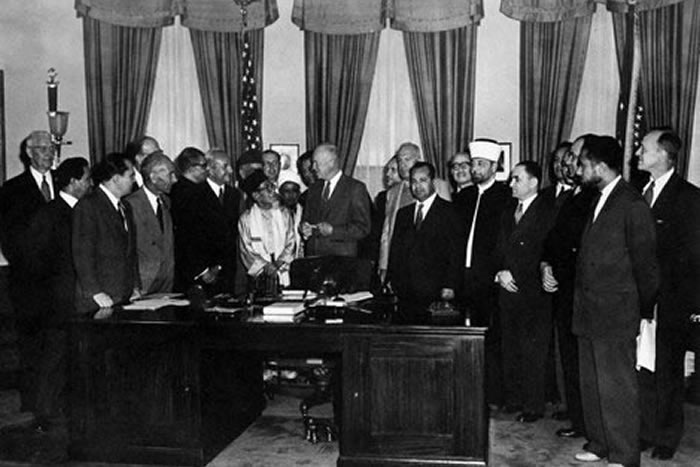
After World War II the pivot was seamless: the CIA adopted Brotherhood networks, with Said Ramadan meeting President Eisenhower in the Oval Office in 1953. French authorities hosted Ayatollah Khomeini in a Paris suburb in 1978–79, allowing him to broadcast the Iranian Revolution via cassette tapes and global media. In 1982 the Reagan administration intervened to extract Yasser Arafat and 14,000 PLO fighters from Beirut under multinational protection. And in the Iran-Contra affair, the United States and Israel secretly sold weapons to the Islamic Republic — a designated terrorist state — while publicly denouncing it.
These were not isolated miscalculations. Western powers repeatedly used Islamist networks as proxies against Nazis, Soviets, and Arab nationalists. Within the inherited framework of Western institutions, an indigenous sovereign Jewish state registers as a destabilizing anomaly while Arab proxy networks feel like a natural, manageable part of the landscape. The result is a functional confederacy that Psalm 83 would recognize instantly.
The Blindness of the Secular State: Toward Civilizational Continuity
A central insight of the series is Israel’s reliance on international law — the Balfour Declaration, San Remo Conference, League of Nations Mandate, and UN Resolution 181 — for its legitimacy. The author argues that seeking approval from institutions whose deepest logic requires Jewish non-existence is a strategic surrender.
Yet a secular democratic state cannot simply pivot to the Tanakh without being dismissed as theocratic. The series points toward a smarter path: a “Civilizational Continuity” framework — intellectual judo that leverages the adversary’s own scriptures.
A recommended diplomatic talking point for Israeli spokesmen:
“Israel’s right to exist does not stem from a 1947 UN resolution; rather, that resolution was a latecomer catching up to a 3,000-year-old reality. Our indigenous presence and historical continuity are corroborated by the foundational texts of the very civilizations — Christian and Islamic — that currently contest our legitimacy. We do not ask you to believe our Book; we merely point out that our presence is affirmed by yours.”
By reframing the argument this way, Israel shifts from defense to offense, using its strongest asset: its presence in the land is the only one in the region explicitly affirmed by the scriptures of its adversaries.
The Cairo–Qom Pipeline: The Theological Wedge
The ferocious anti-Israel doctrine of the Islamic Republic of Iran was not born in Shia tradition. It was imported wholesale from the Sunni Muslim Brotherhood via Sayyid Qutb, whose writings, steeped in Nazi propaganda, framed Jews as a cosmic satanic force. Late Supreme Leader Ali Khamenei personally translated four of Qutb’s major works into Persian in the 1960s and 1970s, establishing a revolutionary messianism that now underpins Wilayat al-Faqih, the theological-political mechanism that makes sustained anti-Israel ideology structurally necessary for the legitimacy of clerical rule in Iran.
The series uncovers a powerful offensive opportunity: using Quranic verses as a theological wedge. Surah 5:21 records Moses declaring the Holy Land “destined” (kataba — divinely prescribed) for the Children of Israel. Surah 17:104 speaks of their future ingathering. This provides theological cover for pragmatic Arab nations. Instead of asking Muslim populations to accept Western secular law, Israel can highlight that normalization aligns with the uncorrupted word of the Quran — isolating the Iranian regime and exposing its ideology as imported radicalism that contradicts the very Book it claims to guard.
The Timeline That Broke the System
The final scriptural blow concerns the “timeline problem.” Both Christian and Islamic supersessionism rest on the claim that Israel was permanently displaced. Yet the 1948 restoration — the revival of Hebrew as a living language and the physical ingathering of exiles from the four corners of the earth — is precisely the event that supersessionist logic forbade.
Jeremiah 31:35–36 ties Israel’s national existence to the ordinances of sun, moon, and stars. Leviticus 26:44 explicitly denies that exile breaks the covenant. History has spoken, and it has sided with the Tanakh.
A Call for Clarity
David Moshe ben Avraham does not present these revelations to induce fear. He presents them to restore clarity. The crafty counsel of the nations is an inherited institutional reflex, but it is refuted by historical fact and scriptural corroboration. For the Jewish people, the call is to master this narrative.
We no longer need to apologize for our existence or beg for recognition from systems built to deny it. The strongest claim any nation has ever possessed is already ours — written in our Torah, fulfilled in our return, and affirmed even by the scriptures of our adversaries.
As Asaph concluded his psalm:
Fill their faces with shame, that they may seek Your name, O L-rd…
Let them know that You alone, whose name is the L-rd,
Are the Most High over all the earth. (Psalm 83:16–18)
I have a concluding question, after having read all FIVE papers. The author is too kind (and maybe blind as well) when he says that Israel can continue to be a secular democratic state while claiming Biblical and Quranic justification for its existence in that form.
I can see why it was allowed to start out this way. However, II Samuel 7 has the prophet Nathan go to King David and tell him that his kingdom would be forever. David, before he was king, called then-King Saul “Melech haMashiach” in a number of different places in I Samuel (24:7, 24:11, 26: 9, 11, 6 & 23). King Saul failed in the eyes of HaShem, Who knew this would happen; David was anointed to take his place back in I Samuel 16. So, my conclusion is that the King of Israel = Mashiach, especially in our time. Only in the halachic kingdom can this be, not in a secular democracy.
I looked at this in Hebrew as well as in English.
What does our author have to say about that? The sun, moon and stars are still here…so is the Kingdom of Israel, at least in potential. When God wills it, it will be in reality.
Shabbat shalom umevorach…and Pesach Sheni sameach.
BTW, I appreciate this set of papers. I would like to present a short version of it to a women’s group I am going to weekly, and even blog about it. May I?
Certainly
https://havahaaharona.blogspot.com/2026/05/a-major-lead-up-to-very-end-more.html
It’s in 2 parts. The first part is about this post including links to this page and the essays.
Thanks so much! I hope this helps.