



In March 2005, as Facebook remained a campus novelty and the first iPhone was still two years from release, a little-known document titled “The Police State Road Map” made a series of stark predictions.
It argued that Western democracies were on a quiet, evolutionary path toward a form of “global fascism,” built on a foundation of total surveillance, militarized policing, and sophisticated information control. The author, Michael Nield, envisioned a future where a small elite would micro-manage society using a technological and legal apparatus of totalitarianism, concealed from a public that would otherwise reject it.
To some, it read like a dystopian fantasy.
Two decades later, an examination of federal law, biometric industry growth, and domestic policing data shows that the document’s core warnings have been validated, and in some cases, surpassed. The architecture of a 21st-century surveillance state has been erected, not by a secret cabal, but through a series of legal, commercial, and cultural shifts that incrementally traded privacy for convenience and civil liberties for promises of security.
A Permanent Legal Architecture
The foundation of the modern surveillance state rests on legal architecture passed in moments of crisis, which has since become permanent.
The 2001 USA PATRIOT Act, rushed into law after the 9/11 attacks, is the prime example. Though many of its most controversial surveillance provisions were set to expire, they were made permanent in 2006, cementing the government’s expanded authority to monitor private communications. The Foreign Intelligence Surveillance Act (FISA) was repeatedly expanded to authorize physical searches and the acquisition of business records, enabling broad data collection that routinely includes the communications of American citizens.
Perhaps the 2005 document’s most prescient warning, however, concerned the use of biology as a tool of state control. That same year, Congress passed the DNA Fingerprint Act, mandating the collection of DNA from any adult arrested for a federal crime. This marked a profound shift, turning DNA collection from a post-conviction tool into a pre-conviction dragnet, capturing the genetic identities of individuals who might never be charged.
The result has been the exponential growth of the FBI’s Combined DNA Index System (CODIS), which now holds the genetic profiles of millions of Americans.
The most alarming expansion, however, came not from a new law, but from a quiet reinterpretation of the old one. In 2020, the Department of Justice reinterpreted the 2005 act to authorize the routine collection of DNA from migrants in federal custody, including asylum seekers and children.
Between 2020 and 2024, this policy funneled over 1.5 million new genetic profiles into CODIS, according to official figures, dwarfing the pace of collection from criminal justice channels. More than 100,000 children and teenagers detained at the border have had their DNA collected and uploaded to a database originally created to track violent felons.
A DNA sample, unlike a fingerprint, contains a person’s entire genome—intimate information about health, ancestry, and family relationships—stored indefinitely by the government. The legal framework for a genetic surveillance state had been laid, not with a bang, but with a bureaucratic memo.
The Commercial Engine of Surveillance
While lawmakers provided the authority, the engine of the new surveillance age was commercial technology. The Silicon Valley boom of the last two decades inadvertently—and at times, intentionally—built the infrastructure that normalized total surveillance as a feature of consumer convenience.
The internet’s open design creates what researchers call the “transparency paradox”: the system’s core functionality is precisely what destroys privacy. Every click and search generates a data trail logged by a host of middlemen, from Internet Service Providers to Content Delivery Networks, feeding massive government and commercial databases.
This collection has been supercharged by the biometric revolution. In 2005, facial recognition was notoriously unreliable. Today, driven by advancements in artificial intelligence, the best algorithms achieve accuracy rates exceeding 97%, according to federal testing, approaching human-level performance.
This technological leap has fueled an explosive market. Valued at over $34 billion in 2022, the global biometrics industry is projected to surpass $150 billion by 2030 and potentially $300 billion by 2034, according to market analyses.
This growth reflects a symbiotic relationship between government and commerce. Governments drive demand with massive national ID programs, while the consumer electronics industry normalizes the technology, making facial and fingerprint scanners a standard feature on billions of smartphones.
The same logic used to track warehouse pallets was soon applied to people. Radio-Frequency Identification (RFID), which replaced barcodes in supply chains, is now used to track patients in hospitals and employees in secure facilities. The first human microchip implant was approved by the FDA in 2004. Today, thousands of people, particularly in Europe, have voluntarily had rice-sized chips embedded under their skin to make payments and unlock doors.
The Militarized Street
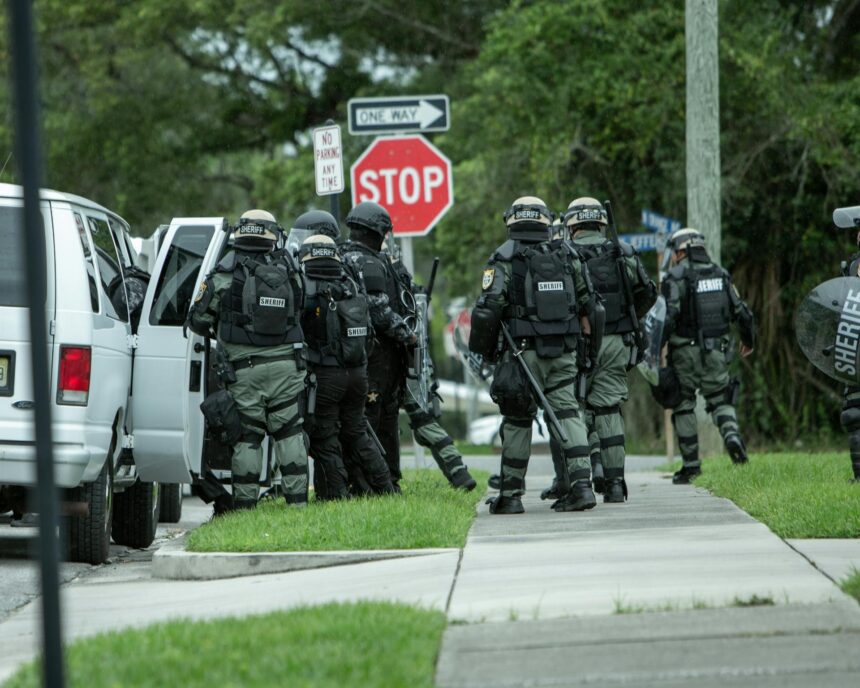
The 2005 document warned of “Martial Law.” While a formal military takeover never occurred, the past 20 years have seen the rise of what criminologists call the “warrior cop” and the steady militarization of domestic law enforcement.
The material foundation for this shift has been the federal 1033 Program, which allows the Department of Defense to transfer surplus military-grade equipment to local police departments for free.
Since its inception, the program has transferred military hardware with an original value of over $8.4 billion to more than 8,800 law enforcement agencies, according to federal data. This includes M-16 rifles, grenade launchers, and Mine-Resistant Ambush Protected (MRAP) vehicles designed for the battlefields of Iraq and Afghanistan.
Public outcry after the heavily militarized police response to protests in Ferguson, Mo., in 2014 led the Obama administration to place restrictions on the program. Those reforms were dismantled by the next administration, demonstrating the trend’s deep institutional foothold.
The operational result has been an explosion in the use of Special Weapons and Tactics (SWAT) teams. In the early 1980s, there were an estimated 3,000 SWAT deployments annually. By 2005, that number had surged to between 40,000 and 50,000. By 2015, it had reached nearly 80,000 per year, according to research by Eastern Kentucky University professor Peter Kraska.
The mission has also changed. An estimated 80% of all SWAT deployments are now for the purpose of serving search warrants, most often for narcotics investigations. The forced-entry military raid, once a tactic of last resort, has become a routine tool of American policing.
The Consent of the Watched
The final component predicted in the 2005 document was control over information. But the reality has proven more complex than simple censorship.
Authoritarian states, such as China, have mastered “digital authoritarianism” by combining surveillance with “infotainment”—building huge audiences with viral content and pivoting that attention to deliver political propaganda, a model now exported to other regimes.
In democracies, control has been a subtler game of consent. The 2005 document assumed the police state would be built in secret because the public would reject it. The reality is what researchers call the “privacy paradox”: Americans consistently express deep concern about their data while enthusiastically adopting the technologies that harvest it.
A 2014 Pew Research Center survey found that 91% of Americans felt they had lost control over their personal information. Yet by 2018, 69% were using social media, the primary engine of the data economy.
This consent extends beyond consumer behavior to the ballot box. For two decades, a bipartisan consensus in Washington has championed and funded the national security apparatus. Politicians from both parties who voted for the PATRIOT Act, authorized FISA expansions, and protected the 1033 program have been consistently re-elected. The political cost of appearing “weak” on security has historically far outweighed the cost of eroding civil liberties. By rewarding “law and order” and “national security” platforms, the electorate has, in effect, repeatedly cast a vote for the very system of surveillance and militarization it otherwise claims to distrust.
Public opinion, polling shows, is elastic and often event-driven. The 2013 revelations by NSA contractor Edward Snowden created a significant, if temporary, shift in public opinion toward prioritizing civil liberties. But after the 2015 terrorist attacks in Paris and San Bernardino, the pendulum swung dramatically back. A Pew survey found the percentage of Americans more concerned that anti-terror policies had not gone far enough (56%) was double that of those concerned about restrictions on civil liberties (28%).
This dynamic reveals that the expansion of state power is not a simple imposition. It is a process that leverages moments of collective fear to gain tacit approval for the next incremental step.
The 2005 “Road Map” was wrong about the how. The transformation was not driven by a shadowy cabal but by the open and explosive growth of the commercial internet. The tools of control were not forced upon an unwilling populace; they were marketed to an eager populace as convenience.
The road to the 21st-century security state was not a secret path. It was a brightly lit superhighway, paved with consumer data, financed by the digital economy, and built, crisis by crisis, with our consent—both the tacit consent of our clicks and the explicit consent of our votes.


And do you believe that the official story of 9/11 is for real, or was it fabricated in order to make bazillions of dollars with endless war, while at the same time taking away the rights and freedoms of citizens and also submerging national sovereignty to international treaties and organizations?