



The Bitter Pill
In the late 1950s, a German pharmaceutical company, Chemie Grünenthal, executed a masterful market strategy. It launched a new sedative, thalidomide, as a “wonder drug” for anxiety, insomnia, and, most lucratively, morning sickness. The public was assured it was so astonishingly safe it could be sold without a prescription. It was presented as a gift to humanity.
But this gift was a calculated deception. The company’s strategy relied on suppressing inconvenient data and pushing claims of safety that its own flimsy testing could not support. The hidden horror within the drug—its ability to cause catastrophic birth defects—was not merely an unknown risk, but a factor deemed acceptable in the cold calculus of market domination. Across 46 countries, the strategy succeeded, and over 10,000 children were born with phocomelia—stunted, flipper-like limbs—the calculated, collateral damage of a successful business plan.
The thalidomide scandal was not a story of a mistake. It was a story of a deliberate strategy, where physical deformity was the known, acceptable price of intellectual and ethical corruption.
This dynamic—a poison knowingly marketed as a panacea to achieve a hidden objective—is not confined to the pharmacy. When the same calculated divergence between public rhetoric and actual policy is deployed at the level of the state, it becomes “political thalidomide.” It is a societal teratogen, a deforming agent administered to the body politic not by accident, but by design. Its purpose is to contort reality, reshape society, and give birth to outcomes that serve a hidden, strategic agenda. The blueprint for this process can be found in the very heart of the scientific enterprise, as diagnosed by a man who saw the rot not as a flaw, but as the system working as intended.
A Prophet in the Science Jungle
In 1967, biochemist Paul Saltman published a blistering critique of his profession titled “The Science Jungle.” He rejected the public image of the noble truth-seeker, revealing instead a system designed to reward not truth, but power. He described a world of frantic, cutthroat competition where the ultimate prize was status within an “egomaniacal” tribe. “The heroes are playing the big stage,” he wrote, “while the peasants are doing the Friday afternoon ten-minute talk in the men’s room.”
This system, Saltman argued, was not accidentally flawed; it was deliberately structured to produce a certain kind of scientist. Graduate school was “semi-slave labor” where professors, driven by the need for grants and publications, demanded data above all else. “I don’t give a damn if you love science,” was the prevailing ethos, “but grind out the numbers!” This process actively filtered out those motivated by joy and discovery, selecting instead for those willing to play the game. It produced “trivial scientists,” but more importantly, it created a culture where dishonesty was a viable career strategy.
The desperate desire to be a hero, Saltman explained, made cheating a feature, not a bug. “By God, you get a theory, it’s beautiful, you love it,” he wrote, “and if the colorimeter doesn’t just record the results you want, you sort of give the machine a little shove.” He recounted stories of faked data and stolen research not as aberrations, but as the logical endpoints of a system that incentivized victory over integrity. Saltman’s “jungle” was not a state of nature; it was a carefully cultivated garden designed to grow ambition and deceit. The corruption was the point. It was the training ground for a mindset that would prove immensely useful to those with power.
Orwell’s Warning: The Lie as a Political Strategy
Decades before Saltman diagnosed the jungle, George Orwell witnessed its ultimate political application. While his masterpiece, Nineteen Eighty-Four, was seeded by the geopolitical carving of the world into “zones of influence,” its central horror—the state’s power to enforce a lie—was inspired directly by a deliberate strategy of scientific corruption.

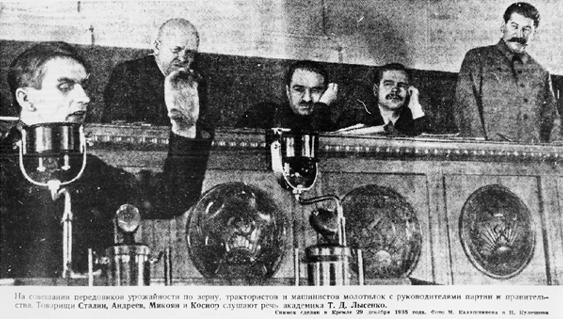
The architect of this strategy was Trofim Lysenko, a Soviet agronomist whose fraudulent theories were embraced by Joseph Stalin. Lysenko rejected genetics and claimed he could “train” crops to produce impossible yields. His science was nonsense, but his political utility was immense. Lysenkoism was a tool, a weapon to enforce ideological conformity and purge the state of independent thinkers. It was a deliberate strategy to demonstrate that the Party had power over objective reality itself.
The brilliant geneticist Nikolai Vavilov, who stood for real science, was declared an enemy of the people, tortured, and left to die of starvation in a Gulag. His elimination was not an injustice; it was a strategic objective. Across the Soviet Union, scientists were forced to publicly embrace Lysenko’s lies. This was the state holding a gun to the head of science, proving that if it could force its brightest minds to agree that wheat can become rye, it could force its citizens to accept any reality it chose to manufacture. The falsification of biology was the dress rehearsal for the falsification of everything. It was political thalidomide in its purest form: a lie administered to deform the mind of a nation.
The Numbers Don’t Lie, But the System Is Designed To
For years, one could dismiss Saltman’s jungle as cynicism and Lysenkoism as a uniquely totalitarian evil. Then, in 2005, a paper by John P. A. Ioannidis, “Why Most Published Research Findings Are False,” revealed that the machinery for producing convenient falsehoods was built into the very structure of modern science.
Ioannidis used mathematics to show how factors like researcher bias, small study sizes, and the overwhelming pressure for positive results create a system where false findings are not the exception, but the norm. From the perspective of a “Deliberate Strategy Premise,” his work is not merely a description of a flawed system; it is an exposé of a system of information control. “Publication bias”—the fact that journals prefer exciting, positive results—is not a passive flaw. It is an active filtering mechanism. It ensures that research aligning with the interests of funders and institutions is amplified, while inconvenient, negative, or null results are systematically buried.
The “publish or perish” culture Saltman decried is the engine of this machine. It incentivizes the rapid production of data, overwhelming the system’s capacity for verification and replication. A single, strategically useful but false study can be laundered into accepted fact. This is not a system for finding truth; it is a system for manufacturing consensus. It is a sophisticated machine for generating the “scientific” justification for any policy or product a powerful entity wishes to promote.
From the Lab to the Ledger: A Strategy of Reckless Disregard
The late Dr. Jay Cavanaugh, a former member of the California State Board of Pharmacy, saw the lethal endpoint of this strategy in the pharmaceutical industry. In his essay “Reckless Disregard,” he casts industry executives not as misguided healers, but as architects of a deliberate and deadly business model. “This collection of serial killers,” he wrote, “extinguishes the hopes and lives of over 100,000 Americans every year.”
Cavanaugh argued that for these entities, human death is not a tragic side effect but a calculated operating expense. “At least the psychotics Manson and Gacy were aware at some level that they were killers,” he charged. “Not the drug companies. To them, the deaths are nothing more than the unavoidable collateral damage in the war on disease and the pursuit of earnings.”
This is the commercial application of the “Deliberate Strategy.” The pressure to “grind out the numbers” in the lab becomes the strategy to generate blockbuster profits. The “shove” on the colorimeter becomes the multi-billion dollar marketing campaign based on selectively published data. He described a world where regulatory bodies act as partners, not watchdogs, and where universities are “co-opted by the drug cartel” to produce research that serves profit, not public health. The system is not broken; it is a finely tuned machine for converting human suffering into shareholder value.
Monsters in the Medicine Cabinet
The official history of the thalidomide scandal casts it as a tragic mistake, an unforeseeable accident of science. The historical record, however, reveals a story of deliberate strategy.
From the outset, the company’s plan was to dominate the market by rushing the drug out on flimsy evidence and aggressively marketing its unsubstantiated safety. When numerous reports emerged that the drug was causing serious, irreversible nerve damage in adults, the company’s strategy was not to investigate, but to suppress the data and discredit the doctors reporting it.
In this context, the subsequent wave of catastrophic birth defects was not an accident. It was the direct and foreseeable consequence of a business model that had already accepted severe human harm as an acceptable price for profit. The physical deformities were the inevitable birth from a womb of calculated intellectual and moral corruption.
The Birth of Political Thalidomide
Now, let us return to Orwell and Lysenko. If pharmaceutical thalidomide is the offspring of a corrupt commercial strategy, then Lysenkoism is the archetype of political thalidomide. It is the deliberate administration of a deforming ideology to achieve a hidden strategic objective. The public is told the policy is a vitamin for national health, but its architects know it is a teratogen designed to reshape the body politic. Its purpose is to create a controlled, manageable, and ultimately useful deformity.
Orwell saw this and predicted its geopolitical endpoint: a world carved into superstates locked in perpetual conflict, each a self-contained ideological universe demanding total conformity. Today, we see his vision materializing in a new global triad: the Western alliance, the Russo-Iranian axis, and the Chinese superpower. Within these blocs, the truth is no longer a goal but a strategic asset, and dissent is not a right but a threat to national security. This is the fertile ground where new and virulent strains of political thalidomide are engineered and deployed.
Our Deformed Reality: A Creature of Design
This brings us to the modern Middle East, and the case of Israel. Viewed through the lens of “inadvertent consequences,” Israeli policy often appears paradoxical or self-defeating. But through the lens of the “Deliberate Strategy Premise,” the contradictions resolve into a coherent, if chilling, design. The apparent paradox of a state that has, at times, allegedly enabled the rise of the very forces it claims to be fighting—such as the early tolerance or even encouragement of Hamas as a counterweight to the PLO—is no paradox at all. It is the core of the strategy.
This is political thalidomide in action. The strategy is not to achieve a stated goal like “peace” or “a two-state solution,” but to create and manage a state of controlled conflict. A fractured, radicalized, and dependent Palestinian leadership is not a failure of Israeli policy; it is the policy’s primary achievement. It provides the permanent justification for security measures, for totalitarian control, and for maintaining a specific political order internally. The chaos is not a bug; it is the feature. The deformity—a perpetual state of war—is the intended design.
The attacks of October 7th, therefore, were not a “failure of imagination” or a “shock” to a system that had blinded itself. They were the horrific, but entirely predictable, culmination of a long-term strategy of cultivating a monster at one’s border. A strategy of political thalidomide, administered over decades, will inevitably give birth to a monstrous reality. The event was not the failure of the policy; it was the policy’s horrifying success, providing the ultimate pretext for a new phase of a long-planned geopolitical project. The historical horror was not an accident born of delusion, but the inevitable birth from a deliberately poisoned political womb.
The Antidote to Deformity
We are living in the world that Paul Saltman and George Orwell warned us about. The “science jungle” has merged with the political jungle to create a system where deliberate deception is the lingua franca of power.
Brothers and sisters, we live in the age of political thalidomide. It is administered daily as state-sponsored disinformation and as calculated policy designed to produce outcomes that contradict its public justification. It promises security and stability, but its hidden function is to create the deformities—the conflicts, the divisions, the chaos—that serve the unstated goals of its architects.
The antidote is not simply to seek truth, but to expose strategy. It requires rejecting the premise of inadvertent consequences and looking for the hidden design behind the apparent chaos. It requires protecting the dissenters and whistleblowers who reveal the divergence between public rhetoric and actual policy. It demands that we, as citizens, develop the courage to see the world not as a series of unfortunate accidents, but as a landscape shaped by deliberate, often malevolent, design.
The choice is ours. We can continue to swallow the political thalidomide offered to us, accepting the official narratives while the world contorts into ever more grotesque shapes. Or we can spit out the pill, identify the poison and its purpose, and begin the arduous work of healing the Creator’s world that has been deliberately deformed.