




In the frantic spring of 2021, a torrent of federal money began flooding the United States. Billed as a lifeline, the American Rescue Plan Act (ARPA) was a monumental financial intervention purported to pull the nation from the depths of the COVID-19 pandemic. For community health centers—the trusted local clinics serving the nation’s most vulnerable—it seemed like a godsend. Millions of dollars were offered to “keep their doors open.”
But this lifeline came with strings attached. An investigation into the specific terms of these federal grants and the actions of the organizations that received them reveals a story not of benign partnership, but of a systemic co-opting of civil society. The unprecedented scale of government funding effectively transformed a wide range of community health organizations from independent entities into de facto agents of the state.
This was not a grassroots mobilization but a meticulously executed top-down campaign of compliance, one that turned trusted local clinics into the frontline enforcers of the government’s vaccination-centric agenda. The very trust these organizations had spent years cultivating was weaponized to overcome skepticism and ensure adherence to federal policy.
Now, in the summer of 2025, as a disease once declared vanquished makes a shocking return, that same machinery of influence is being reactivated. As measles outbreaks flare from Texas to Jerusalem, the playbook of financial coercion, narrative control, and the marginalization of dissent pioneered during COVID-19 is being deployed once more, raising profound questions about whether the official response to public health crises has itself become part of the problem.
The Money Trail
The most effective form of state control is not always the iron fist of force, but the velvet glove of financial dependency. The U.S. government’s pandemic response serves as a model for this form of coercion. Through ARPA and grants disbursed by agencies like the Health Resources and Services Administration (HRSA), the federal government created a financial architecture that commandeered the nation’s community health infrastructure.
The sheer volume of capital was transformative. ARPA delivered an immense $350 billion in funds to support COVID-19 response efforts, with a staggering $7.6 billion explicitly earmarked for community health centers (CHCs) to expand vaccination and testing. This was not a passive offering but an active intervention. The purpose of the funding was unambiguously defined: to “Promote, distribute, administer, and track COVID–19 vaccines,” and to “Detect, diagnose, trace, monitor, and treat COVID–19 infections.” This language left no room for institutional discretion. The funds were not provided for health centers to determine the best course of action for their communities; they were provided to execute a pre-determined federal plan.
Failure to comply carried severe consequences, including the termination of the award. For community health centers serving populations with a limited ability to pay, turning down millions in federal funding was not a realistic option. The government did not need to pass a law forcing CHCs to become vaccination centers; it simply made it financially impossible for them not to. Their primary function shifted from serving the holistic needs of their patients to fulfilling the contractual obligations of their federal paymasters. This deputization of civil society allowed the government to achieve widespread implementation of its policies by co-opting the trusted “community” layer of healthcare, turning local clinics into an extension of the federal bureaucracy.
A Web of Entangled Interests
The federal government’s financial inducements did not enter a vacuum. They were injected into a public health ecosystem already deeply compromised by a web of financial relationships. The fusion of state and corporate power—the so-called “medical-industrial complex”—creates a system predisposed to favor centralized, product-based solutions that benefit entrenched players.
This systemic issue permeates the leadership of the very community organizations that received government COVID-19 funding. An examination of their boards of directors reveals they are often populated not by concerned local citizens, but by individuals with deep ties to the corporate, financial, pharmaceutical, and insurance systems.
The most glaring example is found at the Lakewood Resource and Referral Center (LRRC), which operates the prominent clinic CHEMED in Lakewood, New Jersey. The organization’s 2023 tax filing reports a payment of $449,742 to BP Print Group Inc. for advertising services. The form explicitly states that BP Print Group is an “ENTITY MORE THAN 35% OWNED BY BENNY HEINEMANN, CHAIRMAN.” Heinemann is listed as a board member of LRRC.
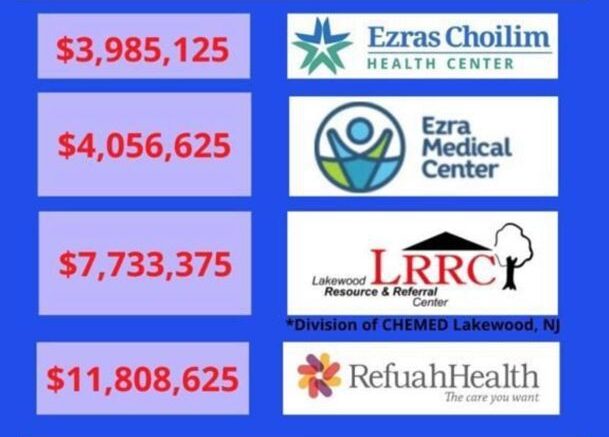
When the chairman of a non-profit that received over $9.4 million in government COVID-19 funds is also the majority owner of a private company profiting directly from that non-profit’s government-funded activities, does this comprise a textbook conflict of interest?
Similar entanglements are visible across other organizations in the region, with board members connected to pharmaceutical development firms and major insurance companies. This pattern reveals a form of capture at the community level. The government outsourced its policy implementation to organizations whose leadership was already aligned with the interests of the pharmaceutical-financial complex.
The “community” in community health center became a brand to be leveraged, not a constituency to be served.
The Ground War on Dissent
This architecture of influence translated directly into on-the-ground action. A necessary precondition for the state’s agenda was the control of information. Any deviation from the official narrative was framed as a dangerous form of “misinformation.” The World Health Organization coined the term “infodemic,” and skepticism was pathologized as a public health threat fueled by nefarious actors. This strategy effectively silenced legitimate debate over vaccine adverse events, natural immunity, and alternative treatments for COVID-19.
This strategy of narrative control is now being repurposed for the 2025 measles outbreaks. Public health officials have been quick to blame the unvaccinated, particularly in Haredi communities, for the disease’s return. Yet this narrative, critics contend, dangerously oversimplifies a complex reality and ignores troubling patterns in the data.
During COVID-19, the vast sums of federal money ensured community health centers acted as proxies for the state’s agenda. CHEMED in Lakewood, after receiving at least $9.4 million, became a major hub for testing and vaccination. Yet in August 2021, OSHA cited the center for two “willful violations” for failing to provide proper protective equipment for nurses conducting up to 300 tests a day, suggesting a prioritization of high-volume government mandates over worker safety. Refuah Health Center, after receiving $11.8 million, launched a public “Get The Shot” campaign, perfectly aligning with its grant requirements to “promote” vaccination.
In both the U.S. and Israel, a perception of a decentralized, community-driven effort masked what was, in reality, a centralized, state-directed campaign executed through financially dependent proxies.
Echoes of the Pandemic: The Measles Resurgence
In the summer of 2025, the return of measles provided the first major test of the post-COVID public health apparatus, and the response has been eerily familiar. As cases climbed past 1,400 in the U.S. and a smaller but significant outbreak of over 70 cases hit Israel, authorities launched emergency vaccination campaigns, mirroring the urgency of the pandemic. But a growing number of independent researchers are pointing to a disquieting correlation: first come the mass vaccination drives, and then, in their wake, the outbreaks appear to intensify.
In Texas, after state health authorities administered over 173,000 MMR doses between January and March, the state was grappling with more than 700 cases by May. In one Gaines County example, a targeted drive with just 80 doses was reportedly followed by a 242% leap in local infections. A similar pattern has been noted in Israel, where an emergency campaign has been shadowed by a continued escalation of the outbreak. This has led some to ask an unsettling question: is the official response fanning the flames?
The core of this question lies in the nature of the MMR vaccine, which uses live, weakened viruses. While the medical establishment has long assured the public of its safety, a body of scientific literature confirms that the vaccine virus can replicate and “shed,” meaning it can be transmitted from a recently vaccinated person.
A 2024 study in the Journal of Clinical Virology found that over a third of recently vaccinated children shed measles vaccine RNA for up to a month. While not proving causation, this documented phenomenon has fueled concerns that mass vaccination campaigns could, ironically, contribute to community spread. This theory found further support when wastewater surveillance in Canada detected the vaccine’s specific genotype in 8% of samples, confirming the virus is being shed into the environment on a population-wide scale.
Furthermore, critics argue that the exclusive focus on vaccination status ignores other critical factors, such as the quality of medical care. The tragic deaths of two young girls in Texas in February 2025, six-year-old Kaley Fehr and eight-year-old Daisy Hillebrand, were immediately used to stoke fear. However, a meticulous review of their medical records by Dr. Pierre Kory, a critical care specialist, concluded they died not from measles, but from tragically mismanaged secondary bacterial pneumonia for which they did not receive timely, appropriate antibiotics.
This echoes reports from a 2019 measles outbreak in Samoa, where officials were accused of suppressing the use of Vitamin A—a proven, WHO-recommended therapy that can cut measles mortality in half. Just as with COVID-19, the suppression of alternative, effective treatments—such as the use of inhaled steroids, with which Texas physician Dr. Richard Bartlett has reported rapid recoveries in over 100 measles patients—in favor of a rigid, vaccine-centric protocol appears to be a feature of the official response.
A Crisis of Conscience and a Question of Capture
The state’s top-down agenda has repeatedly created a profound crisis of conscience, particularly in Orthodox Jewish communities with strong traditions of internal authority. During the COVID-19 pandemic, public health officials in Israel pursued a calculated strategy to secure endorsements from the country’s most influential Haredi rabbis.
Recognizing that their word often carries the weight of law, senior health officials engaged directly with religious leaders. The key to this strategy was leveraging the community’s trust in specific medical authorities. The state’s medical advice was effectively translated into religious guidance through Rabbi Elimelech Firer, the widely respected head of the Ezra LeMarpeh medical charity, who counseled leading figures like Rabbi Chaim Kanievsky and Rabbi Gershon Edelstein to endorse the national vaccination program. This created a powerful perception of unified religious and medical consensus.
However, the 2025 measles outbreak has exposed deep fissures in this model, revealing a dynamic that dissenting voices within the community describe as outright capture. In August 2025, the prominent Badatz Eidah Hareidis issued a terse, unsigned “halachic ruling” urging parents to vaccinate their children immediately, framing it as a matter of pikuach nefesh—a life-or-death imperative.
Critics immediately pointed out that the statement lacked any of the traditional hallmarks of a rabbinic ruling: there was no detailed analysis, no citation of Torah sources, and no reasoned argument. When pressed for answers, a representative for the Badatz refused to name any doctors or rabbis associated with the ruling and stated that all questions should be directed to an outside organization called “Yad Avraham.”
Further investigation revealed that the Badatz representative claimed the ruling was merely a renewal of a 25-year-old statement and that Yad Avraham had simply requested they issue it. This has led to accusations that the Badatz, until now one of the most revered bodies in the Haredi world, was merely acting as a rubber stamp for an outside agenda, lending its religious authority to a directive it could not—or would not—defend on its merits.
This episode laid bare the sophisticated mechanism of social control. The state and its public health apparatus identified religious authority not as a belief system to be respected, but as a strategic tool to be weaponized.
By working through intermediary organizations like Ezra LeMarpeh and Yad Avraham, the state could launder its directives through a trusted community filter. This tactic reframes a legitimate medical debate over risk and bodily autonomy into a matter of religious obedience versus heresy. The dissenting rabbis and community members are thus positioned not merely as individuals questioning a medical product, but as outliers resisting the combined will of both secular and religious authority—a profoundly coercive tactic that seeks to eliminate the space for individual conscience.
A Deforming Agent
The through-line from the COVID-19 response to the 2025 measles resurgence suggests a systemic issue that transcends any single virus. Some analysts have begun to describe the modern public health strategy as a form of societal teratogen—a deforming agent administered to the body politic. In this view, a policy is publicly marketed as a safe and necessary wonder drug, while its architects are aware of its potential for harmful, deforming effects that serve a hidden, strategic objective.
The thalidomide scandal of the 1950s provides a chilling historical parallel. A drug marketed as a safe sedative, particularly for morning sickness, was rushed to market based on flimsy data, causing catastrophic birth defects in over 10,000 children. This was not merely a mistake, but the consequence of a deliberate business strategy that prioritized market domination and treated severe human harm as an acceptable cost.
Critics now argue that our public health system, deeply entangled with pharmaceutical interests and government power, operates on a similar model of reckless disregard, where inconvenient data is suppressed, dissent is crushed, and human suffering is considered collateral damage in the pursuit of policy goals and profits.
The ultimate deformity is not physical, but societal: the erosion of trust, the corruption of science into a tool for manufacturing consensus, and the creation of a permanent state of crisis that justifies ever-increasing levels of social control.
The evidence from the past five years demonstrates a clear pattern. The combination of massive, conditional government funding, pre-existing corporate conflicts of interest, and the strategic co-opting of community institutions has created a powerful, coercive apparatus.
The ultimate authority in any medical decision must rest not with the state, but with the individual. But during the COVID-19 era, and again today, that principle has been systematically undermined.
The long-term cost is not measured in dollars, but in the trust that has been broken—trust in our doctors and medical institutions, in our community leaders, and in a government that has used public health crises to tighten its grip by co-opting the very institutions meant to protect us.