


Reports issued this week by Magen David Adom and hospital authorities contain a set of statistics that demand a rigorous re-evaluation of our national psyche. While the eyes of the world are fixed on the technological duel between interception systems and Iranian ballistic missiles, the data suggests that our most immediate physical threat is found in our own mirrors.
Over 120 individuals were treated for injuries in the initial escalation; of those, at least ninety were sustained not by the impact of projectiles, but by the frantic rush to reach safety or the subsequent toll of acute anxiety. These figures reveal a stark, uncomfortable truth: the official government response to the conflict is currently exacting a physical toll comparable to the weapons of our adversaries.
In my own life, having faced the direct aim of an assailant on multiple occasions only to see the bullets miss their mark, the distinction between what we call “objective reality” and Hashgacha Pratit, or Divine Providence, has effectively dissolved. To live in this land is to recognize that there is no line separating the two. We are forced to confront the foundational reality of our existence as articulated in Pirkei Avot, which reminds us that against our will we were formed, against our will we were born, and against our will we live and die. This is not a call to fatalism, but a demand for logical consistency.
The current crisis has exposed the devastating paradox of the shelter. In Bat Yam, 102-year-old Yosef Ben-Shalom, a man who survived a century of history, saw his life end on a communal stairwell—not by shrapnel, but by a fall sustained during the midnight rush for a basement. He is joined in this ledger of tragedy by a 68-year-old woman in Tel Aviv, who died of severe respiratory failure triggered by shortness of breath while moving toward a shelter during a siren. For these citizens, the rush to safety itself was the lethal event.
Simultaneously, the massacre in Beit Shemesh provides a somber refutation of the shelter as an absolute sanctuary. Nine souls, including the Biton siblings—Yaakov (16), Avigail (15), and Sara (13)—and Sara Elimelech (mother) with her daughter Ronit, as well as Bruria Cohen (mother) with her son Yosef, Gavriel Baruch Revach (16), and Oren Katz, followed every protocol and reached their designated shelter inside a synagogue. Yet, they perished when a heavy ballistic warhead breached the structure, collapsing the concrete roof and killing those inside amid a barrage that also injured over 40, including young children. To believe that safety is found merely by moving from point A to point B assumes that we possess a map of a strike that has not yet occurred. There is no counsel against the Almighty, and speed is not a savior.
To ground this perspective in a broader context, one must methodically compare the risks we fear with those we have normalized. We find ourselves in a state of normalized acceptance regarding the daily dangers of the road, while maintaining a state of extreme terror regarding a conflict risk that is, by any measurable standard, orders of magnitude lower.
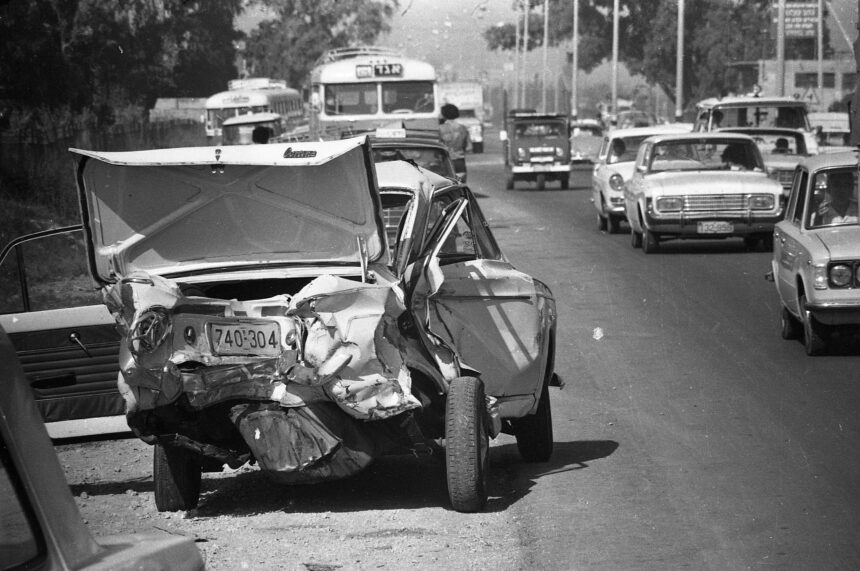
In Israel, the statistical reality of the road is far more lethal than the reality of the rocket. We accept as a baseline of modern life that approximately ten to twelve thousand accidents involving casualties will occur annually on our streets, resulting in hundreds of fatalities. Statistically, an individual navigating the streets of Jerusalem or Tel Aviv faces a significantly higher probability of being harmed by a motor vehicle than by a projectile.
The “intent” of the missile overrides the “outcome” of the car, leading to an habituated overreaction that often proves more dangerous than the threat. When the siren sounds, the most profound act of religious and psychological victory is the “slow walk.”
By walking at a measured, intentional pace, we regulate the nervous system and refuse to be the instruments of our own injury. We can utilize the rhythmic mantra of Pirkei Avot as a somatic tool: Against—my—will—I—live.
My survival is not a function of the thickness of a concrete ceiling or the speed of my feet, but of a Divine will that remains constant. We are told that a thousand may fall at our side, yet it will not touch us if it is not so decreed.
By rejecting the frantic rush, we do more than prevent a fall; we defeat all of our enemies’ primary objective – no matter who they are or where they operate.
Their goal is cause us to fear anything besides the Creator; our response must be the cultivation of an unassailable internal bitachon – trust.
In this land, finding that peace is a clinical necessity for our survival.

Excellent job of putting danger into perspective, thank you.
It’s true that fear often derives from our imagination (as you noted, imagining danger increases with falling missiles toward a Holy Am in our Holy Land, rather than the statistically more probable danger of vehicular accidents).
And your excellent advice for the slow-walk of emunah.
To prove your point: Just now, we discovered that one of the people who died in Tel Aviv was a 68-year-old woman (not sure whether Jewish or not) with a Russian name who died as she hurried to the bomb shelter.
(At least, that’s the information we have up until this point.)