


The Script We Were Never Meant to Read
In the cynical world of Washington policy, documents are weapons and influence is the currency. Reports from elite think tanks are not academic exercises; they are blueprints, “menus” of options presented to policymakers who will, in turn, shape global events.
It is rare, however, for such a document to emerge from the archives with such startling, clarifying, and cynical prescience as “Which Path to Persia?,” a 2009 position paper from the Brookings Institution.
Unearthed and re-examined in the context of 15 years of Middle East turmoil, the paper does more than just offer strategies for confronting Iran. It provides a disturbing validation for analysts who have long argued that the region’s conflicts are not a series of chaotic, accidental fires but a single, controlled burn.
The document, authored by the very core of the U.S. foreign policy establishment, lays bare a calculated plan. It casts allies and adversaries alike as pieces on a chessboard: an Iran to be goaded or crippled, Gulf states to be quietly protected and elevated, and an Israeli Prime Minister, Binyamin Netanyahu, to be utilized as a convenient lightning rod to absorb the political and military fallout for the United States.
This 2009 paper acts as a Rosetta Stone, translating the seemingly contradictory and self-defeating policies of the last decade-and-a-half. It lends powerful credence to analyses suggesting that Israel’s strategic actions, often portrayed as independently sovereign, may in fact follow a script written in Washington—a script designed to manage American decline, deflect culpability, and ultimately secure a new regional order favorable to its Gulf allies.
The Washington Consensus in One Room
To understand the paper’s gravity, one must first understand its source. The Brookings Institution is not a mere academic enclave. It is, arguably, the most influential think tank on earth, a centrist “government-in-waiting” whose fellows and scholars fluidly rotate between its stately Massachusetts Avenue offices and high-level positions at the State Department, the National Security Council, and the Central Intelligence Agency. When Brookings speaks, it does so with the authority of the “Washington Consensus.”
The paper’s authors are not fringe theorists; they are the high priests of that consensus. The list includes Martin S. Indyk, a two-time U.S. Ambassador to Israel and former Assistant Secretary of State for Near Eastern Affairs, a man who has been at the center of every U.S.-led “peace process” for decades. It features Kenneth M. Pollack, a former CIA analyst and NSC official whose 2002 book, The Threatening Storm, was instrumental in making the “liberal hawk” case for the Iraq War. It includes Bruce Riedel, a 30-year CIA veteran and senior advisor to multiple presidents on the Middle East and South Asia, and Daniel Byman, a premier counterterrorism expert.
These are the practitioners. They are the men who brief presidents, draft policy memos, and draw the maps. When they collaborated in 2009 under the auspices of the Saban Center for Middle East Policy at Brookings—a center founded by Indyk—to create a “menu of options” for the new Obama administration, they were not guessing. They were presenting a viable, actionable playbook. Their recommendations, including the most cynical, were intended to be taken seriously.
“Leave it to Bibi”: Israel as the Lightning Rod
The most explosive section of the 156-page document details a variety of military options. Tucked away in Chapter 5 is a strategy so brazen it has to be read to be believed: “Leave it to Bibi: allowing or encouraging an Israeli military strike.”
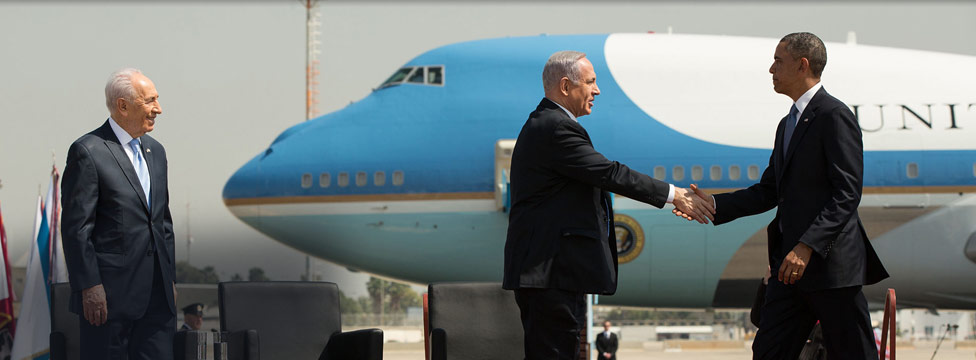
The plan is simple. The United States wants to neutralize Iran’s nuclear program but wishes to avoid the political toxicity, international condemnation, and direct military retaliation that would follow a U.S. strike. The solution? Get Israel to do it. The paper outlines the goal as destroying key Iranian nuclear facilities to delay its weapons capability. But the U.S. benefit is stated in chillingly clear terms: the United States would reap the rewards of the strike “without taking the risks of using its own forces,” thus “deflect[ing] international criticism and Iranian retaliation away from the U.S. and onto Israel.”
This single passage provides stunning validation for a thesis long advanced in analyses published by Jewish Home News. These articles have persistently questioned the narrative of Binyamin Netanyahu as a wholly independent actor, suggesting instead that his political function, perhaps wittingly, is to serve as a shield for larger U.S. interests. His bellicose rhetoric and “rogue” actions, in this light, are not a bug but a feature—a performance that allows Washington to achieve its strategic aims while publicly distancing itself. The Brookings paper is the missing script for that performance, casting Netanyahu by name (“Bibi”) as the man for the job.
The authors were not naive about the risks. They note that an Israeli strike would be weaker than an American one and would face immense logistical hurdles, including overflight of Jordan, Iraq, Turkey, or Saudi Arabia. More importantly, they concede the “deflection of culpability” is highly uncertain. If the U.S. were to grant Israel a “green light” to use U.S.-controlled Iraqi airspace, Washington would appear to be a “witting accomplice,” negating the entire point. Furthermore, since the Israeli Air Force flies American-made F-15s and F-16s, sustained by billions in annual U.S. aid, the paper concludes that “Iran would likely blame Washington as much as Jerusalem for the attack.”
This apparent contradiction only deepens the cynicism. The goal was never to fully convince Iran, but to create plausible deniability for the international community and the American public. The strategy confirms a pattern of “policy by paradox” that Jewish Home News articles have highlighted, where Israel is pushed to act, seemingly alone, to service a U.S. strategic goal, only to be “restrained” by its American patron on the world stage, all while absorbing the global diplomatic fallout.
Riyadh’s Silent Victory
If the Brookings plan casts Israel as the regional lightning rod, it just as clearly identifies the ultimate beneficiary: the Kingdom of Saudi Arabia and its Gulf Cooperation Council (GCC) allies.
Jewish Home News has repeatedly argued that the central drama of the Middle East is not, as often portrayed, a simple battle between Israel and its neighbors. Instead, they posit a “stealth” contest for regional dominance, with Saudi Arabia using its immense oil wealth and U.S. patronage to outmaneuver rivals like Turkey and Egypt, all while positioning Israel as a “sacrificial pawn” to confront its primary nemesis, Iran. The Abraham Accords, in this view, were not a “peace” deal but the formalization of this strategic deception.
The 2009 Brookings paper is the doctrinal origin of this very strategy. The authors explicitly identify the GCC states as America’s “most concerned” allies regarding Iran. The benefit of an Israeli strike, the paper details, would be paramount for these “conservative monarchies.” The document explains that Gulf rulers live in mortal fear of a nuclear-armed Iran, which they believe would “redouble its efforts to stir up the down-trodden shi’i populations of the GCC” and “otherwise try to subvert or overthrow” their regimes.
An Israeli strike, planned in Washington, elegantly solves Riyadh’s problem. It removes the existential nuclear threat, cuts back Iran’s regional aggression, and, crucially, prevents a destabilizing nuclear arms race that the paper notes Saudi Arabia and the UAE were already threatening to join.
The political convenience is the masterstroke. The Gulf states, as the paper notes, would never publicly support an American or Israeli military operation against a fellow Muslim state, fearing it would “create far more problems than it would solve.” The “Leave it to Bibi” option provides them with the perfect cover. They get to see their primary regional rival crippled by their other regional rival, all while issuing pro-forma condemnations of “Zionist aggression” from the safety of their palaces. It is the ultimate “Empire by Stealth” maneuver: a strategic victory won without firing a shot, paid for with Israeli blood and political capital.
A Region Arranged
The strategic benefits are not limited to the Arabian Peninsula. The Brookings paper outlines how an Israeli strike, by weakening Iran, would conveniently stabilize the entire region in America’s favor.
In Iraq, the authors note, “few Iraqis… would want to live next to a powerful, aggressive Iran.” A strike would reduce Tehran’s ability to wield influence over armed militias, a goal shared by both U.S. forces and Iraqi leaders. In Afghanistan, it would diminish Tehran’s willingness to arm groups fighting U.S. and NATO forces.
Even Turkey, a complex regional player, is noted as being “privately panicked” about a nuclear Iran. While an Israeli strike would be politically complicated, it would serve Turkey’s core interest in non-proliferation and potentially reduce Iranian support for groups like the PKK.
The picture that emerges is one of a meticulously arranged chessboard. The 2009 paper reveals that the U.S. policy establishment saw the entire region as a system to be managed. An Israeli strike was not envisioned as an isolated, desperate act of self-defense, but as a calculated move with predictable ripple effects, almost all of which were beneficial to U.S. allies and interests, leaving only Israel and Iran to pay the direct price.
From Blueprint to Reality: The Fifteen-Year Echo
The “Which Path to Persia?” paper was written in 2009. It is the 15-year echo, the clear line from that blueprint to the events of today, that is most chilling. This document powerfully refutes the notion that recent Middle East policy is a series of “inadvertent consequences” or “well-meaning buffoonery.” It validates the Jewish Home News thesis that we are witnessing a deliberate, if cynical, long-term strategy.
The paper, after all, was a “menu.” The Obama administration initially chose a different item from that menu: engagement, which ultimately led to the 2015 JCPOA (Iran nuclear deal). But when that option was discarded by the next administration, the military and covert options—including “Leave it to Bibi”—remained fully on the table.

The 2020 Abraham Accords are the most significant implementation of the Brookings strategy. They are the diplomatic crystallization of the paper’s core premise: the formal alignment of Israel and the Gulf monarchies, united by their shared U.S. patron and their shared fear of Iran. The Accords created the very anti-Iran coalition that the 2009 paper identified as the main beneficiaries of a strike. It was the necessary diplomatic groundwork before the “Bibi” option could be fully viable.
This context re-frames the entire narrative. The persistent shadow war, the “maximum pressure” campaigns, the targeted assassinations, and the constant, destabilizing speculation about an imminent Israeli strike are not random noise. They are the visible implementation of a long-standing, calculated policy.
This aligns perfectly with Jewish Home News analyses of the “policy paradox” in Gaza, where seemingly contradictory actions—such as allowing Qatari aid to flow to Hamas while simultaneously preparing for war with Iranian proxies—are not strategic blunders. They are components of a single, cynical management strategy, designed to keep all actors in their pre-determined boxes, manage regional tensions rather than solve them, and pursue the larger geopolitical goal: a U.S.-dominated new world order, anchored by Saudi capital and secured by Israeli military muscle.
The 2009 paper’s analysis of Judea and Samaria, and the “final capitulation” on Jerusalem, also fits this model. In a system where Israel’s function is to act as a U.S. proxy, its own sovereign claims—whether on its heartland or its capital—become negotiable. They are bargaining chips to be traded for the larger strategic prize, such as a U.S.-Saudi defense pact, which itself is just one more brick in the global totalitarian superstate that Jewish Home News articles warn against.
The Brookings paper is a rare, unvarnished look at the cold calculus of empire. It confirms the darkest suspicions of independent analysts: that events are being deliberately shaped, that allies are being strategically betrayed, and that the fates of nations are being decided in Washington conference rooms by men who will never have to live with the consequences of the “options” they recommend.