


A Shot Heard Across Time
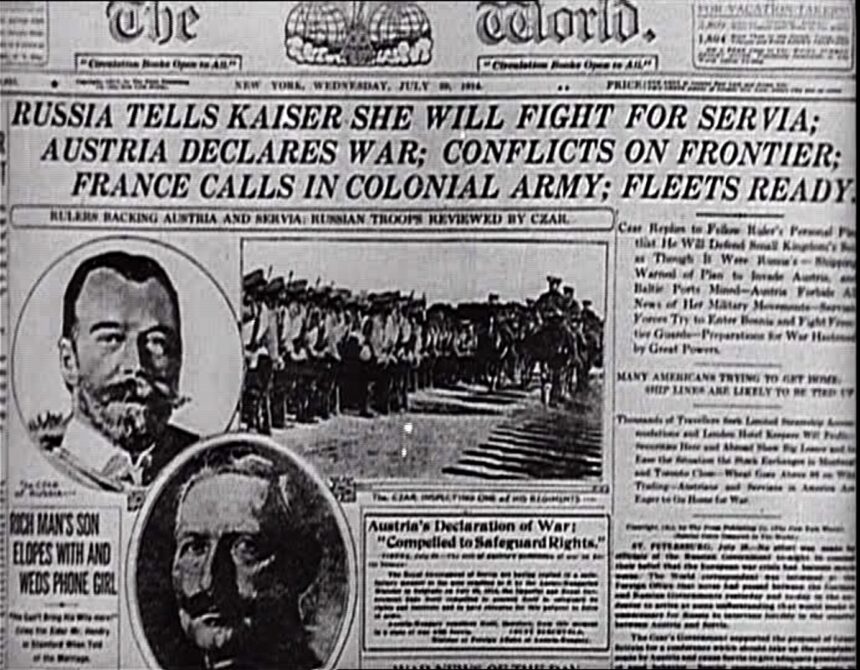
It began, as world-changing events sometimes do, with a single act of violence on an obscure side street. On June 28, 1914, in the provincial city of Sarajevo, a young Serbian nationalist named Gavrilo Princip fired two shots, killing Archduke Franz Ferdinand, the heir to the sprawling Austro-Hungarian Empire.
The act was local, fueled by a bitter ethnic grudge against an imperial power. Yet, it was the spark that lit the fuse of a global powder keg. Within weeks, the intricate web of European alliances had pulled the continent’s great powers into a catastrophic war that would redraw maps, topple empires, and claim more than 16 million lives.
Historians have meticulously documented the political and military blunders of the July Crisis that followed—the rigid ultimatums, the failed diplomacy, the inexorable march of mobilization schedules. But to view the outbreak of World War I solely through a modern political lens is to miss a deeper pattern that reveals an historical pattern.
For those who track the rhythms of history through a different calendar, the date of the assassination was not just another summer day. It was the Ninth of Av, or Tisha B’Av, the most solemn day of mourning in the Jewish calendar, the anniversary of calamities that have befallen the Jewish people. Among them: the destruction of the Second Temple in Jerusalem by the Roman Empire in 70 C.E.
That the first shot of the “war to end all wars” was fired on this specific day of remembrance is a “coincidence” that Jewish thinkers have long found significant. It suggests an echo, an historical resonance. Jewish sources that describe the fall of Jerusalem reveal a chain of events that bears an uncanny resemblance to the spiral of 1914. It is a cautionary tale, preserved for two millennia, that seems to have played out again, on a global scale, in the capitals of modern Europe.
The Dinner Party That Doomed a Nation
The poignant account of the Temple’s destruction, found in the Talmud, does not begin with Roman legions. It begins at a dinner party, an event that became a tool for political sabotage. The story tells of a wealthy man in Jerusalem who, intending to invite his friend Kamtza, mistakenly sends the invitation to a certain Bar Kamtza—a known member of the pro-Roman “peace party” of King Agrippa.
When Bar Kamtza arrives, the host, likely seeing him as a collaborator, publicly ejects him. Desperate to avoid shame, Bar Kamtza pleads, offering to pay for the entire feast, but the host refuses. The sages and leaders present sit in silence, helpless to de-escalate the politically charged scene.
Humiliated, Bar Kamtza and his political faction seized upon the incident. It was not mere personal revenge; it was a calculated political maneuver. He went to the Roman emperor, claiming the Jews were in revolt. As proof, he engineered a provocation: he would bring a sacrificial calf, supposedly from the emperor, which he had secretly blemished. When the Temple authorities inevitably rejected the invalid offering, it would be presented to Rome as an act of rebellion.
The plan worked perfectly. The blemished calf arrived, and the Jewish leadership was thrown into paralysis. Some argued for accepting the illegal offering to preserve the nation. But one influential sage, Rabbi Zechariah ben Avkilus, prevailed. A man of meticulous, unwavering devotion to religious law, he argued that accepting the animal would set a dangerous precedent. His rigid adherence to principle, in the face of a political trap, led to a fatal deadlock. As Rabbi Yochanan would later lament, “The piety of Rabbi Zechariah destroyed our Sanctuary.”
From Political Plot to Catastrophe
The Romans, their offering rejected, interpreted it as rebellion. The incident, intentionally manufactured by an internal faction, escalated. Emperor Nero dispatched his general, Vespasian, to quell the supposed uprising. The legions marched on Judea.
This history diagnoses the sickness that brought down Jerusalem. The catastrophe was not simply a matter of Roman might; it was the result of internal political rot. A public incident was weaponized by a collaborationist faction to paint their own people as rebels. A leadership, trapped by its own principled rigidity, was outmaneuvered and failed to de-escalate.
The external enemy, Rome, was merely the instrument of a destruction made possible—and even initiated—from within. Historical accounts, including those of Josephus, confirm the broader theme: Jerusalem was besieged not only by the Romans but by its own warring internal factions, zealots who burned the city’s food supplies to force a fight, ensuring that famine would ravage the population before the Romans ever breached the final wall.
Nineteen Centuries Later, The Same Mistake
Nearly nineteen centuries later, the curtain rose on a strikingly similar drama. The assassination in Sarajevo was the modern equivalent of the Bar Kamtza incident—a localized act of political hatred, carried out by a nationalist faction to deliberately provoke a crisis. What followed was a month-long diplomatic standoff that mirrored the rabbinic paralysis in Jerusalem. Austria-Hungary, backed by Germany, issued an ultimatum to Serbia, a series of demands designed to be impossible to accept. Like Bar Kamtza offering to pay for the feast, Serbia conceded to almost every point but balked at the most intrusive one.
It was a moment for compromise. But the leaders of Europe, much like Rabbi Zechariah, were trapped by situation and principle. Their minds were governed by an unforgiving system of alliances, mobilization timetables, and national pride. Russia, the protector of the Serbs, began to mobilize. Germany, bound by treaty to Austria-Hungary, declared war on Russia and its ally, France. Its war plan required invading neutral Belgium, bringing the British Empire into the fray.
Each step was logical within the flawed framework of the time, yet each step led closer to the abyss. The spirit of principled inflexibility in the face of provocation was present in every capital. The generals insisted on their timetables, the diplomats on their ultimatums, and the kaisers and kings on their honor. The internal divisions of Europe—the rivalries and deep-seated suspicions—ensured that a regional crisis, sparked by a political faction, could not be contained. They created a chain reaction that no one could stop.
The Fire This Time
The parallels are as clear as they are chilling. A local spark, ignited by a political faction, creates a crisis. The leadership fails to act creatively, paralyzed by a principle that is exploited by provocateurs. The situation escalates, drawing in larger imperial powers in a domino effect. And crucially, the internal divisions and baseless hatreds within the community—or the continent—are the fatal weakness that allows the external forces of destruction to prevail.
But what if this pattern of self-destruction is not an iron law of history, but a choice? What if the same dynamic—a small spark igniting a world-altering conflagration—could work in reverse?
Jewish tradition, which so carefully preserves the memory of its own failings, also preserves a powerful counter-dynamic, a prophecy of hope that acts as an inverse image of the catastrophe. In the Tanach, in the short, searing book of Ovadiah, a different kind of fire is foretold.
The prophet directs his vision against Edom, the nation that celebrated Judah’s destruction and who became synonymous with the Roman empire that would later burn the Second Temple. While history saw Rome act as the fire and Jerusalem as the kindling, Ovadiah prophesies a stunning reversal: “And the house of Yaacov shall be a fire, and the house of Yosef a flame, and the house of Esav for stubble… and they shall kindle them, and devour them.”
Here, the chain reaction is not one of hatred leading to ruin, but of redemption leading to triumph. The oppressed become an unstoppable fire, and the seemingly mighty oppressor is revealed to be as vulnerable as dry straw. It is the same historical mechanic, the same exponential spread, but fueled by a different energy. The prophecy suggests that the catastrophic patterns we have known are not destiny. They can be inverted.
This ancient message of hope is not a passive promise of a distant future; it is a call to action. The sages who blamed the Temple’s fall on baseless hatred taught that its rebuilding would come through its opposite: baseless love.
If a single act of animosity, left unchecked by a silent community, could spiral into global disaster, then perhaps a single act of reconciliation, of return—what is known in Hebrew as teshuva—could be the spark that ignites a redemptive flame.
The prophecy of Ovadiah is a reminder that history’s trajectory is not fixed. The future does not have to be an echo of the past’s darkest moments. The fire can be ours to light.