



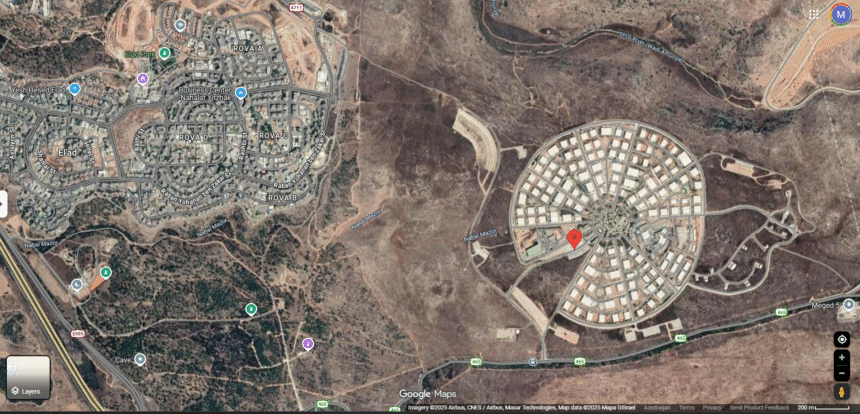
Just east of the sprawling haredi city of Elad, hugging the faint trace of the 1949 Armistice Line – the so-called Green Line delineating Israel from Judea and Samaria – lies a vast military installation. With its distinctive, almost futuristic circular layout stark against the arid hills, Nachshonim Base stands out on any satellite map.
Officially, it’s a state-of-the-art logistics and supply depot for an Israeli Defense Forces (IDF) reserve armored division. Its construction, completed in the mid-2000s, was largely financed by the United States as part of a package deal brokered under the 1998 Wye River Memorandum. The documented purpose? To facilitate the IDF’s withdrawal from parts of Judea and Samaria by providing modern facilities within or near Israel’s internationally recognized borders.
But in a region defined by contingency planning and worst-case scenarios, could this sprawling, secure compound serve another, unstated purpose? As talk of potential Palestinian statehood ebbs and flows, and with it the politically explosive question of Jewish towns deep within Judea and Samaria, some observers question whether facilities like Nachshonim, strategically located and heavily secured, might be earmarked – officially or unofficially – as potential holding or processing centers should a mass evacuation or expulsion of Jewish residents ever occur.
It is a question rooted not just in the base’s location and scale, but in Israel’s complex and often criticized history of handling large, displaced populations – even its own citizens. Official plans often meet harsh realities, and the results, critics argue, have sometimes prioritized state policy over individual welfare. Could Nachshonim, despite its designation as a logistics hub, become an ad hoc solution in a future crisis?
A History of Makeshift Solutions
Israel’s history is punctuated by mass movements of people, both inward and outward. While celebrated for absorbing waves of immigrants, the state’s handling of these influxes, and of its own citizens displaced by policy, has faced sharp criticism.
In the 1950s, hundreds of thousands of Jewish immigrants, predominantly Mizrahim from Arab lands, were housed in temporary transit camps known as ma’abarot. Often consisting of tents or rudimentary shacks lacking adequate sanitation, employment, or social services, these camps became symbols of hardship and alleged discrimination against Mizrahi Jews, fostering grievances that lingered for decades. Critics point to the ma’abarot as an early example of the state prioritizing rapid absorption over the immediate well-being and integration of newcomers.
Following the 1982 peace treaty with Egypt, Israel evacuated the Sinai community of Yamit. While evacuees received compensation packages, reports emerged of bureaucratic delays, inadequate long-term housing solutions, and psychological distress among the former residents, who felt abandoned by the state that had encouraged their presence there.
A similar pattern emerged after the 2005 withdrawal from Gush Katif in Gaza, which involved the uprooting of nearly 9,000 Israelis. Despite government promises and significant financial aid, the resettlement process was plagued by problems. Many families spent years in temporary housing (“caravillas”), facing unemployment, community disintegration, and battles for promised infrastructure. Critics described the government’s post-evacuation support as poorly planned and insufficient, leaving deep scars on the evacuee community.
More recently, during the COVID-19 pandemic, Israel utilized hotels to quarantine travelers and infected individuals. While intended as a public health measure, the program faced criticism regarding conditions, inconsistent enforcement, lack of adequate medical and psychological support in some facilities, and the feeling of confinement experienced by those held, sometimes against their will.
These historical precedents, critics argue, demonstrate a pattern: in times of crisis or large-scale displacement driven by state policy, the Israeli government has sometimes resorted to ad hoc, temporary solutions that prioritized the immediate logistical challenge over the long-term, dignified resettlement of affected populations. The focus, they contend, has often been on moving people quickly, with less regard for the conditions they face afterward. Could such a pattern repeat itself?
The Doctrine vs. The Hangar: Standards for Resettlement
If a mass displacement occurred, what would constitute an appropriate response? The U.S. Army, a key Israeli ally and the funder of Nachshonim, has its own detailed doctrine for handling “Dislocated Civilians” (DCs) – FM 3-39.40, Internment and Resettlement Operations. While distinct from handling prisoners or detainees, resettlement operations focus on quartering civilian populations “for their protection” or due to displacement from conflict or disaster.
The manual emphasizes “humane treatment” and outlines minimum requirements for temporary or semi-permanent resettlement facilities. Sanitation and hygiene are crucial for preventing disease outbreaks in dense populations, requiring sufficient latrines (ideally 1 per 15 people, segregated by gender), showers, hand-washing stations, potable water for drinking and hygiene, and waste disposal systems. Medical care access is essential, including screening upon arrival, routine sick call, emergency care, and potentially isolation areas, alongside considerations for mental health support.
Basic shelter protecting from the elements is a minimum, ideally comparable to standards for military forces, with tents acceptable if buildings aren’t available. Food rations must be sufficient in quantity, quality, and variety to maintain health, considering cultural habits, and safe food preparation areas are vital.
The site itself must be safe, away from combat hazards and internal dangers. Administrative and processing areas are needed for registration, information dissemination, and coordination with aid organizations. Finally, while maintaining family unity is prioritized, provisions must exist for segregating unaccompanied minors, genders, and potentially conflicting groups. This doctrine clearly envisions facilities designed, or at least adequately adapted, for human habitation.
Nachshonim: The “Unsuitability” as Proof?
Viewed through the lens of FM 3-39.40, Nachshonim Base presents a stark contrast. As a logistics depot, its primary structures are likely warehouses, vehicle maintenance bays, supply storage areas, and administrative offices for military personnel.
On the surface, these structures exhibit severe deficiencies for resettlement. They lack adequate sanitation – imagining thousands sharing limited military base toilets highlights the significant health risk. They lack appropriate medical facilities scaled for civilians, safe mass food preparation areas, and internal divisions for privacy or necessary segregation. By the U.S. Army’s own doctrine for humane resettlement, the base appears grossly unsuitable.
But this “unsuitability” may be precisely the point. If one analyzes the base not as a potential home but as an industrial tool for processing a displaced population, its design makes a different, more cynical kind of sense. In a catastrophic scenario, the sheer volume of enclosed space within its hangars and warehouses offers rudimentary shelter, and its secure perimeter ensures containment. Using Nachshonim’s hangars would be akin to using warehouses or sports stadiums – options widely recognized as inadequate but employed globally in emergencies to “manage” a crisis rather than humanely “solve” it.
Strategic Location
Yet, the base’s location remains intriguing. Nachshonim sits directly on the “Green Line,” roughly 25 km east of Tel Aviv. It lies adjacent to Route 444 and near the major Route 465, providing access both into central Israel and eastward into Judea and Samaria. Critically, it is positioned near the western edge of a major bloc of Israeli communities in Judea and Samaria, including Ariel further east and numerous smaller towns.
In a scenario involving a withdrawal or evacuation from these areas, Nachshonim would be one of the first large, secure Israeli installations encountered by people moving westward. Its location makes it a potential bottleneck, checkpoint, or initial processing point, regardless of its suitability for long-term housing.
Capacity and Precedents
Estimating emergency capacity is difficult. UNHCR emergency standards suggest a minimum covered floor space of 3.5 square meters per person. A large military hangar or warehouse might offer several thousand square meters. Stuffing people well beyond minimum standards, one might hypothetically fit thousands into each large structure. If the base contains multiple such structures, a total emergency shelter capacity in the tens of thousands is not implausible, albeit under potentially dire conditions lacking basic sanitation and services.
While not ideal, the use of military bases and non-traditional structures for displaced populations has precedents globally. Fort Dix in New Jersey housed Kosovo refugees in 1999 and Afghan evacuees in 2021. During the European Migrant Crisis starting in 2015, various countries utilized decommissioned military barracks, airports like Berlin’s Tempelhof, and industrial buildings as temporary shelters. Following hurricanes in the US, sports stadiums like the Superdome after Katrina and convention centers have often served as mass shelters of last resort. These examples frequently highlight the challenges inherent in such solutions: inadequate sanitation, lack of privacy, difficulties providing services, and potential for tension and insecurity – precisely the concerns raised by potentially using a logistics base like Nachshonim.
Other Facilities?
Nachshonim is not unique. The IDF operates other large logistics and ordnance depots. While a comprehensive list is sensitive, bases near key junctions or community blocs might also possess large structures. However, Nachshonim’s relatively modern construction (post-Wye River funding) and specific location make it a notable example.
The Bucket on the Train: A Question of Intent
The official “documented purpose” of Nachshonim Base—to support IDF redeployment—raises a glaring question. Is it plausible that the Clinton-era architects of the Wye Memorandum, men engaged in the cold calculus of redrawing maps, would meticulously plan for the movement of soldiers and tanks but completely overlook the fate of the half-million Jewish residents living in the very territory being negotiated?
From this critical perspective, such an omission is a political impossibility. The “problem” of the civilian population had to be foreseen. Therefore, logic dictates that some contingency must have been made.
However, a public plan to build “resettlement towns” would have been politically catastrophic. It would have been seen as a profound betrayal by the Israeli right, likely collapsing the government, while simultaneously being condemned by “Palestinians” as new infrastructure for Israelis near the Green Line. If a provision was made, it had to be hidden. It needed a plausible, military-logistical cover story that justified its size, security, and U.S. funding. A “logistics and redeployment base” is the perfect disguise.
This leads to a darker interpretation, one that echoes the cynical tokenism described by Ben Hecht in Perfidy. Hecht questioned the two buckets—one for water, one for human waste—placed in cattle cars packed with 80 Jews headed for Auschwitz. He concluded their presence was not for the prisoners’ welfare, as they were wholly inadequate, but for the perpetrators—a minimal, bureaucratic gesture, a “German memory of humanity not quite dead” that allowed the planners to manage an inhuman process.
Could Nachshonim Base be a modern-day “bucket on the train”?
In this framework, the base’s very unsuitability for humane resettlement is not a flaw in the theory, but the proof of its cynical purpose. It was never intended to be a home; it was intended to be a tool. Like Hecht’s buckets, it is a minimal, industrial “solution” that allows distant policy architects to check a box, managing a human catastrophe without humanely solving it. The lack of 10,000 toilets and kitchens is not an oversight; it is the evidence that the facility was designed for mass processing and containment, not for resettlement.
Adding another layer of complexity are unconfirmed reports, circulating outside official channels, suggesting the Wye River agreement contained a secret annex specifically mandating the construction of facilities for the future internment of Jewish residents. While no official confirmation of such an annex exists, these persistent rumors, combined with the base’s very existence, fuel the speculation.
The official answer, if asked, would be clear: it is a logistics base.
But given Israel’s own history of pragmatic and often-criticized ad-hoc solutions, the cold logic of political necessity, and the base’s stark physical potential, the question remains. Does Nachshonim possess a latent, secondary capability that aligns with the “cold calculus” of planners?
Without access to classified documents, the answer is speculative. But the base’s existence serves as a stark, physical reminder of the unresolved questions surrounding the future of the communities in Judea and Samaria.


I think Nachshonim will turn out to be a concentration camp. For Jews. America has never been entirely on our side, and possibly never has been, at all; her relationship with us may possibly turn out to be worse than that of the Soviet Union.
However, I never thought I would be writing thoughts like this. I do recall it being written (I don’t remember exactly where, but it was a prominent American magazine, I am fairly certain) at least 5 decades ago, that America hugs us with one arm and stabs us, or does something similar, with the other. The cloak she wears is cover for her abusive treatment of Israel. That was hard for me to believe; but, seeing it over the last 18 years that I’ve lived in the Holy Land, has made me understand what was written back then, sometime between the 6-Day War and the Yom Kippur War, most likely.
HaShem must intervene, and quickly!